
PRODUCT UPDATES · OCT 9, 2026 · 4 MIN READ
Reading the note as the visit happened: negation, on-study visits and blind-grading adjudication
Week 41, 2026: grading decides negation from the note, ctcae.ai runs an on-study visit, and blind-grading studies adjudicate and export by grade.
Burna AI Team
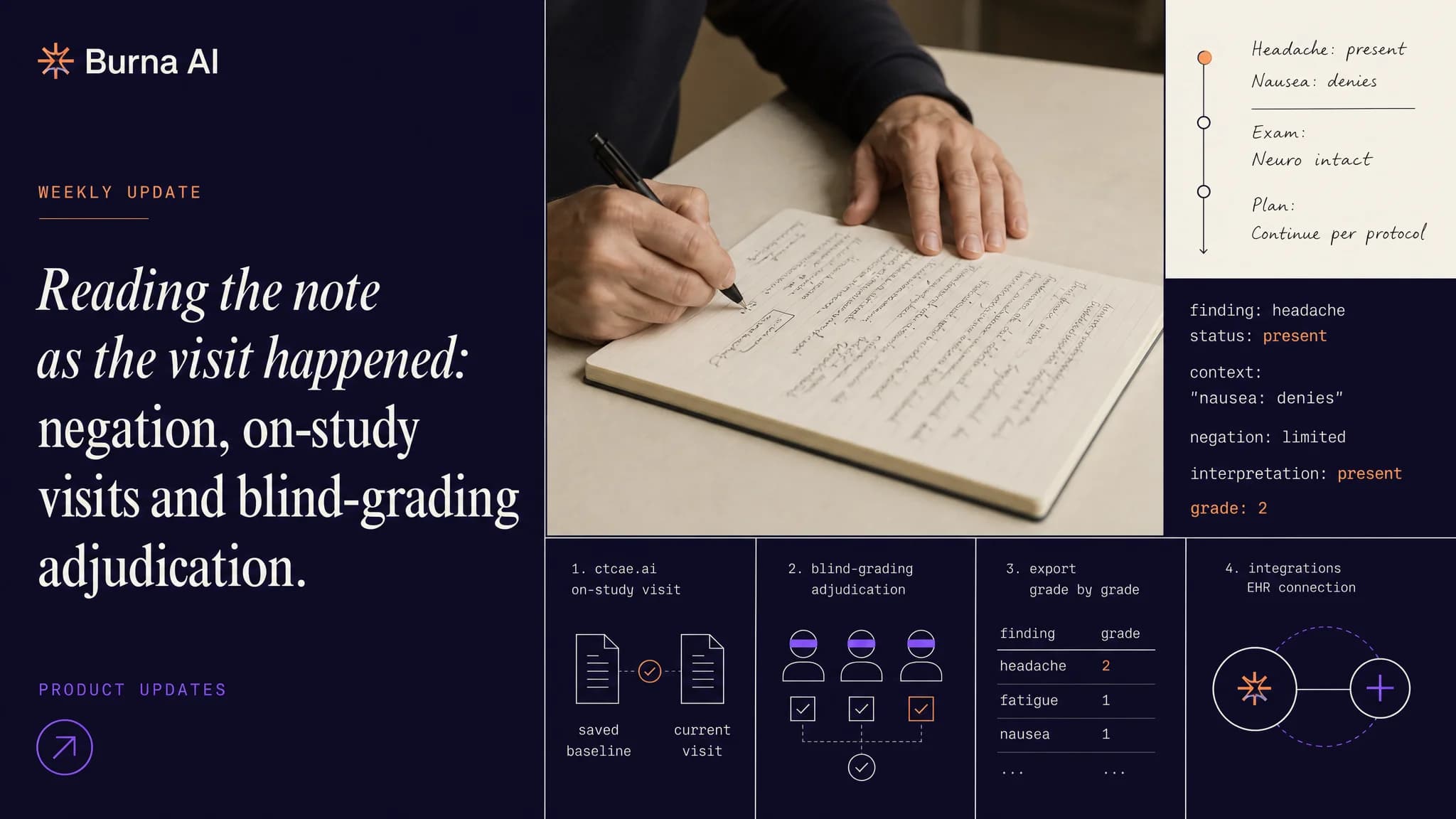
A clinical note is written by someone describing a visit, not filling in a form. "No dyspnea at rest" and "shortness of breath with routine activity" can sit in the same paragraph, and both are true: the patient is short of breath on exertion and not at rest. A grading system that treats the first sentence as a denial of the second has read the words and missed the visit.
Week 41 of 2026 (5 to 9 October) was about reading the record the way the visit happened. Grading now decides whether a finding is present from the note itself wherever the note settles it. ctcae.ai carries a patient's history and last visit's open adverse events into the next visit. And blind-grading studies, the controlled way to measure how grades agree, now run from first rating to adjudicated export inside the platform.
The architectural commitment underneath all three is the same one: every grade traces to the line in the medical record that produced it. When the system decides a finding is present, the reviewing clinician sees the sentence that says so.
A present finding stays present beside a limited denial
Whether a finding is present or denied is now decided from the note wherever the note's own wording settles it. The extraction model's reading is overridden in exactly one pattern: a denial limited to a situation, such as "at rest", beside a mention saying the patient has the finding now. That override needs positive evidence in the note, such as a present-tense verb or a window running to today, and it stands down for a past event, a plan, a hedge, history, or another person's symptoms. Where the note is unclear, the model's own reading stands.
The same work reads a coordinator's plain description as the finding it names, so "itchy" grades as Pruritus. Pancytopenia is graded as its three counts, Anemia, Neutrophil count decreased and Platelet count decreased, each graded once. A follow-up question about an earlier result is graded against the note it asks about, and an event that has not been graded shows "Not graded" rather than a grade of zero.
An on-study visit on ctcae.ai
ctcae.ai, the free CTCAE site for research teams, now runs a visit the way a coordinator works one. A Visit setup sheet holds the patient's medical history, one condition to a line or pasted from an EDC export, and the open adverse events from the last visit. Each entry is previewed with its CTCAE v5.0 and v6.0 term and grade before it is saved.
Paste the visit transcript and the reply sorts every adverse event into what is new, what changed, what resolved and what is already history. A pseudo patient carries the setup from one visit to the next, with every unresolved event dated for the coordinator to confirm, so grading stays continuous without an identified record. A lab value is read in its direction: a hemoglobin of 8 reads as anemia.
Blind-grading studies, from rating to adjudicated export
Blind grading is how a site or sponsor measures agreement: raters grade the same cases independently, and an adjudicator settles where they differ. This week the adjudication flow was rebuilt for the people who run it. The Adjudicator tab appears only for adjudicators. A rater sees a case they rated only once their own grades are submitted. Finalizing a case is a typed attestation, recorded with its meaning and an entry in the audit trail.
Selected cases export as CSV, PDF or Excel, one row per grade, and the export writes its audit entry before any grade is read. Platform staff can run AI grading on a study's notes beside the human raters; those grades are stored apart from rater submissions, sit in their own rows in the export, and are visible to platform staff only. A hand-added adverse event records the CTCAE publication it was picked from, and large caseloads load in batches with search across the whole set.
The encounter, from the provider's side
Connecting Oracle Health from Integrations now completes end to end, and the connection status says what EHR sync can do: Available, Awaiting authorization or Connected. Epic and Oracle Health sandboxes are listed first for a site testing the connection.
On the encounter review, open events from earlier visits, concomitant medications and baseline history sit together in one group. An encounter where every grade is undetermined records that there is nothing to attribute yet, with the reason, rather than failing. A provider can edit a patient's details from the profile header, a row in the encounter queue opens its encounter on click, and the provider mobile app shows grades in the same order as the web.
Also in week 41
- Switching organization takes effect at once. After accepting an invitation, or creating or leaving an organization, every page reflects the new organization immediately.
- One invitation per invitee. A resend replaces the earlier invitation, which lasts the 14 days the page states.
- Every dropdown in the provider app now uses one design-system control, and choosing the value already selected changes nothing.
Where this sits
Burna AI is the AI platform for accelerated clinical research, from first-in-human trials through postmarket surveillance.
Burna AI performs automated adverse event grading and attribution in real time, providing clear rationale and audit-ready evidence, including generation of IRB, sponsor and FDA reports. Burna AI delivers CTCAE v5 and v6 grades and MedDRA LLT codes on every encounter; enabling standardization, cross-site consistency and accuracy of clinical research data. AI suggests, clinicians decide. Human-in-the-loop, always.
If your site, sponsor team or CRO wants to see a grade traced to the sentence that produced it, book a 15-minute conversation.