
Get the label right the first time.
Attribution that’s accurate during the trial gives you the right label, the right dosing interval and the right monitoring schedule at approval. Burna scores it at the encounter, at every site, with the evidence attached. Protocol Studio reads your protocol the way sites will.
The label you write once.
An event you catch during the trial becomes a line in your label. The same event found after approval becomes a label change, a safety communication, a revised dosing interval, and the cost of taking the drug back out.
Telling the true and related from the true and unrelated, early, is where that money is made.
Caught during the trial
One line in your label.
The dosing interval, the monitoring schedule and the warnings, right the first time.
Found after launch
A label change.
- A safety communication.
- A dose adjustment.
- The cost of taking a drug back to market.
One adverse event, and the two futures that fork at approval. Illustrative rendering.
“If I have a delay on a study of three months… this drug two years later will be a blockbuster. A billion dollars in one quarter of a year. A billion dollars is 250 million dollars missing… And a patient who has metastatic disease may not have a quarter year of time to wait for the drug.”
The attribution decision is made at 40 to 200 sites.
Your sites don’t document to the same standard, and you won’t see the spread until central review, months later. Burna grades every site against the same criteria and the same algorithms, and shows you the variance while the trial is still running.
During amendment implementation, your sites run on mixed protocol versions for an average of 215 days. An amendment that changes attribution should reach every one of them in hours.
share of events each site attributes to the study drug
Forty sites on one trial
amendment approved
all sites aligned
average 215 days (mixed protocol versions)
real-time propagation: hours
One protocol, forty sites, forty documentation habits. Illustrative rendering.
Source: Tufts CSDD.
Every safety platform you own starts after the decision.
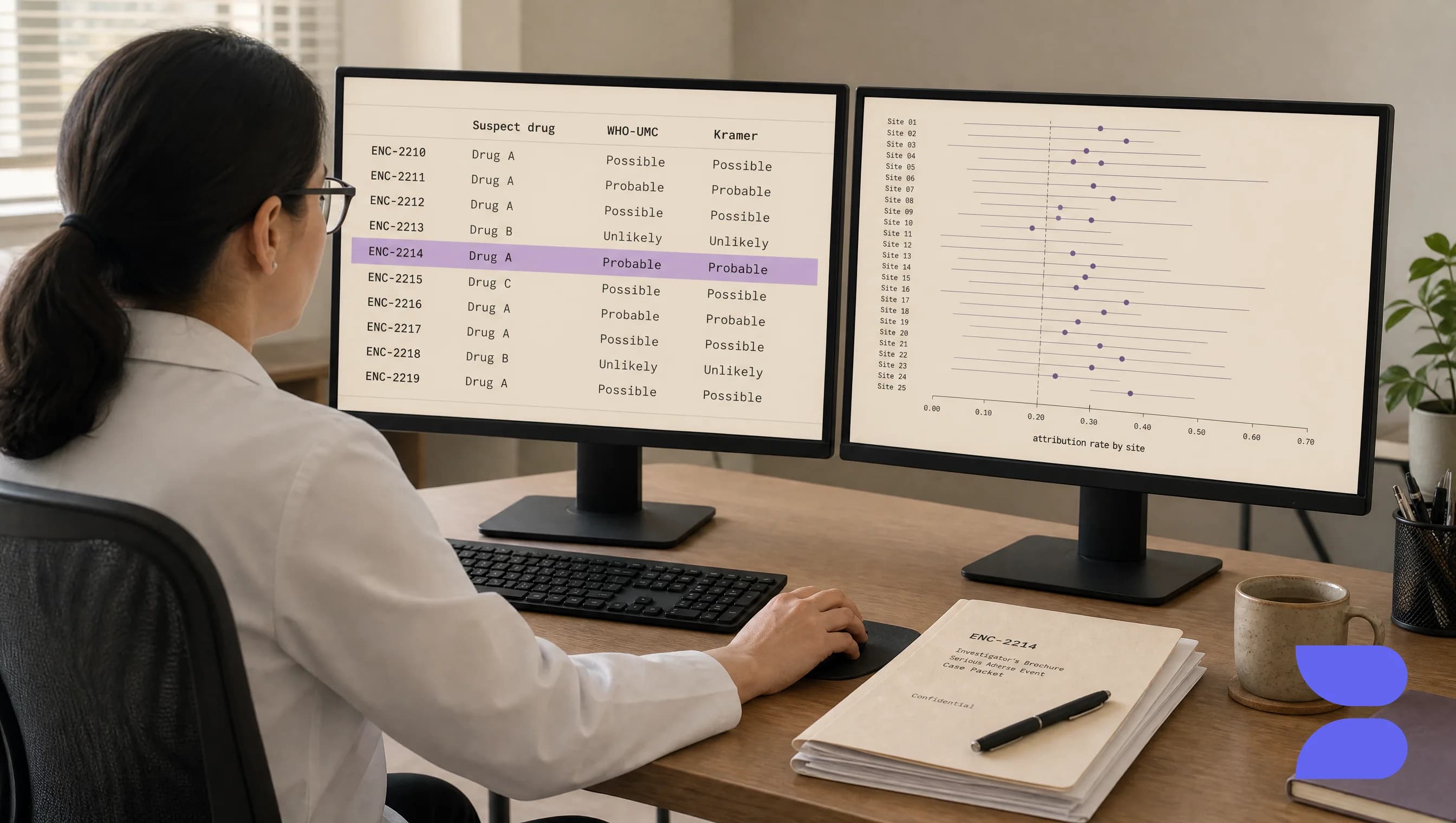
Argus, LifeSphere and Vault Safety manage the ICSR lifecycle once attribution has already been made. Burna is where your investigator makes it, with WHO-UMC and Kramer scoring shown per drug, the evidence in view, and the reasoning inspectable before anyone signs.
clinical encounter
Attribution decision
ICSR lifecycle (Argus, ArisGlobal, Vault...)
Burna operates here
every existing vendor
Upstream of the ICSR.
seconds
next monitor visit
EVENT
SITE 01
SITE 02
SITE 03
SITE 04
SITE 05
SITE 06
SITE 07
SITE 08
Illustrative rendering
Finding the low-grade events early is upside.
A serious event genuinely attributable to your agent surfaces eventually, and it’s far cheaper to hold at the label stage than after a safety communication.
It’s the grade 1 and grade 2 events that tell you the dosing interval wants changing, the schedule wants changing, or a subpopulation is carrying risk your protocol didn’t anticipate. The dose you want often sits below the maximum tolerated dose.
“Pharma is going to be conflicted because they kind of wish there weren't any. It's a little bit like going to a health system and saying we're going to look for HIPAA violations.”
Read your protocol the way a site will.
Protocol Studio runs a draft protocol against itself before any site opens it. Every conformance finding comes back with both passages, their pages and the amendment cause it would become. It quotes the protocol and concludes nothing.
Where the graded record lands is a separate question. It travels to you rather than waiting to be collected.
Burna writes outward to the capture system each study already runs. A site is never asked to change the stack it uses for every other sponsor.
The record arrives with its CTCAE version, its criterion, its attribution and the line in the source note that produced it. That is the same evidence your investigator signed.
Where no direct connection exists, the export carries the identical record. Your study starts on the day you sign, not on the day an integration finishes.
The same engine keeps working after approval.
Your postmarket events run through the same engine and come back as submission-ready narratives. Every output carries the criterion it was graded against and a 21 CFR Part 11 signature, so an inspector opens the same evidence your investigator signed.
An estimated 11% of deaths in oncology are attributable to poor adverse event management.