
PRODUCT UPDATES · MAY 29, 2026 · 3 MIN READ
Copy-forward detection reads patient reports and clinician grades together
Copy-forward detection now reads patient self-reports and clinician grades as one evidence stream, adding a fifth signal: the patient's symptoms moving while the documented grade stands still. Recording is separated from grading and falls back across audio formats.
Burna AI Team
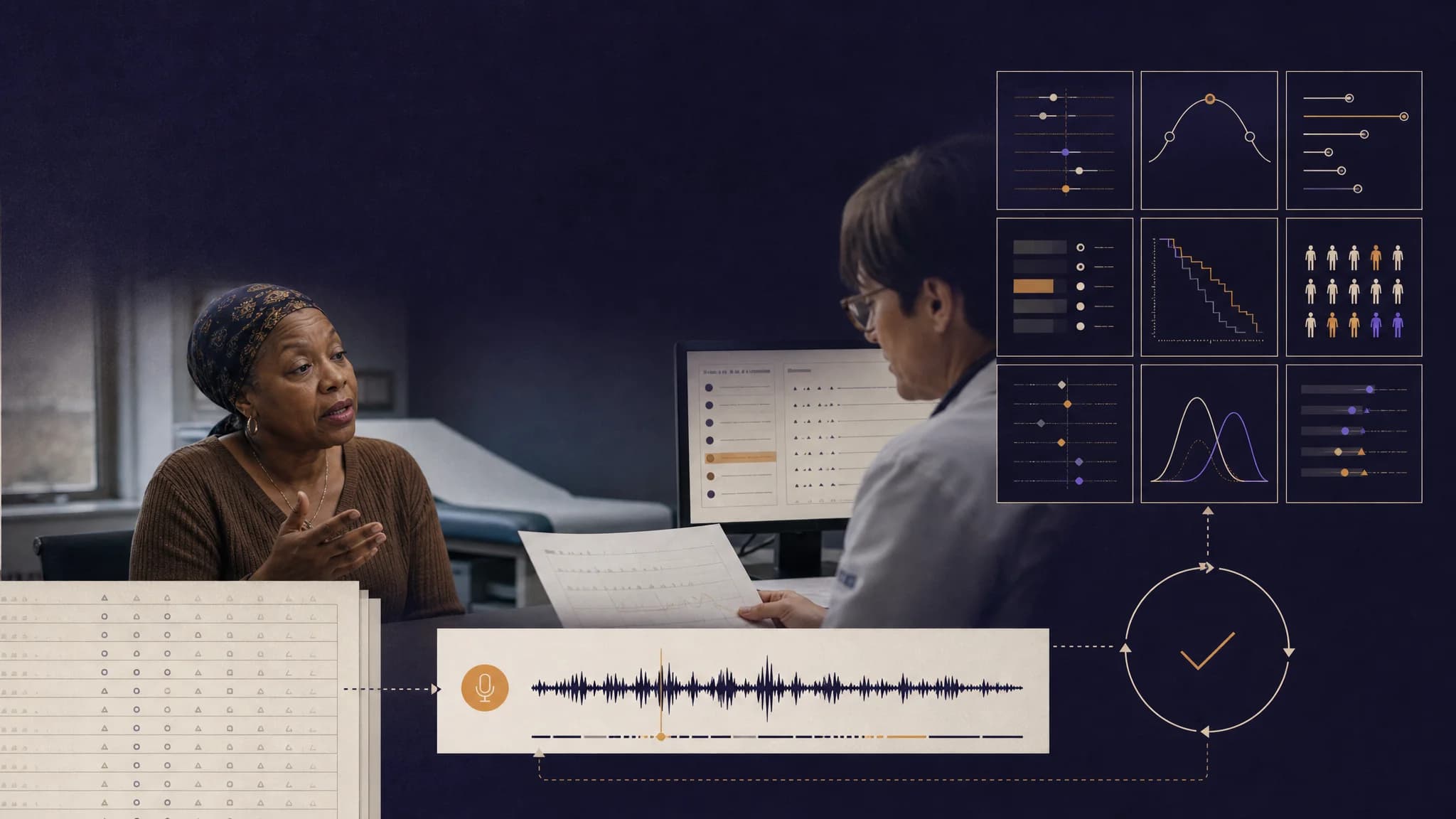
Burna AI copy-forward detection, part of the platform's Documentation Quality Assessment, flags an adverse event grade that is carried from one visit to the next without being reassessed. In week 22 of 2026 (25 to 31 May), it began reading patient self-reports and clinician grades as one evidence stream, which adds a fifth signal to the four it already checked: the patient's reported symptoms moving while the documented grade stands still. The same week separated recording upload from grading and put nine animated figures of the platform's architecture on the public site.
How Burna AI copy-forward detection works
Copy-forward detection reviews each CTCAE term in a patient's history across visits and flags a term only when two or more of five signals are present:
- Grade stagnation: the same grade for three or more consecutive visits.
- Evidence repetition: the clinician's supporting text is nearly identical from visit to visit.
- Temporal implausibility: the grade holds while the treatment changed or significant time passed.
- Missing reassessment: no new clinical data supports the current grade.
- Patient-reported divergence: the patient's self-report shows the symptom shifting while the clinician's grade stays put.
One signal is never enough. Some adverse events genuinely persist at one grade, chronic neuropathy among them, so stagnation alone raises no flag. Each flag carries a confidence score, and flags below a floor, 60 out of 100 by default, are held back. Detection starts once a patient has three graded visits. Both thresholds can be set per organization.
Why copy-forward in oncology notes needs the patient's report
A copied-forward grade looks consistent, and nothing in the note itself shows that the assessment was not repeated. The patient is an independent source. When a participant reports a symptom easing or worsening between visits while the clinician's grade has not moved, the gap between the two is evidence the chart alone cannot supply.
This week both streams began writing to the same per-patient memory: clinician grading after each grading run, and patient self-reports from the symptom check-ins in the trial participant app. Detection counts observations from each source separately. When a patient has no self-reports, the divergence signal records "not available" rather than "no divergence", so a missing report is never read as agreement.
Two design choices keep detection out of the clinician's way:
- Detection starts after the grading run completes and runs independently of the page, so navigating away from the encounter does not cancel it.
- Patient reports feed detection asynchronously, so a participant's check-in submits as quickly as before.
In this first release, detection ran in the background behind a per-organization switch. Each run recorded what it found and what the confidence floor held back, so alert quality and both thresholds could be measured on real encounters.
For the documentation problem behind the feature, read how copy-forward and note bloat distort adverse event data. The short answer is in the FAQ on how Burna AI catches stale clinical documentation.
Since then (August 2026): the trial participant app is now Healthnotes, the participant app sponsors deploy through sites.
Recording upload separated from grading
The recording screen in the web provider app now does one job: capture the audio and upload it. Grading runs downstream of the upload.
- A submission completes when the upload succeeds.
- A failed upload shows an error and returns the screen to a state where the clinician can submit again.
- Upload failures are classified as authentication, network or server errors, so each can be handled and monitored on its own terms.
- The recorder picks an audio format the browser supports, falling back from WebM with Opus to WebM, then MP4, then the browser's default, so a browser without Opus still records.
- Grading starts for an encounter with no patient profile attached, instead of waiting on a comorbidity lookup with nothing to return.
Since then (July 2026): the web provider app was retired in favor of the platform at app.burna.ai.
Nine animated figures of the architecture
The public site replaced several of its product videos with nine animated figures, built as components whose data shapes follow the product's own: citation steps, attribution and memory events. They included the twelve specialized agents in a cascading constraint pipeline, the grading workbench with citation tracing, a multi-source patient memory timeline and the copy-forward guardrails. A gallery gave each figure its own link.
Since then (August 2026): burna.ai was rebuilt, replacing that site, and the figure gallery is retired.
Also shipped in week 22
- Password setup. Users who sign in with an emailed code or a social account can add a password and then sign in either way.
- Next check-in date. The participant app's completion screen shows the next check-in date from the submission response, says the care team will confirm it when none is scheduled, and the enrollment, review and completion screens fit small devices.
- Readable sign-in in dark mode. Muted text on the participant app's sign-in screens rose from 3.2:1 to 5.5:1 contrast, meeting WCAG AA, and the help button clears the status bar on notched phones.
- Narrower trusted origins. The API's cross-origin allowlist moved from wildcard subdomains to named app subdomains.
AI suggests, clinicians decide. Human-in-the-loop, always. For a walkthrough of how Burna AI reads a patient's record across visits, book a 15-minute conversation.