
PRODUCT UPDATES · JUL 10, 2026 · 3 MIN READ
A patient context pipeline that holds through every step of grading
The Burna AI patient context pipeline keeps a patient's note, grades, attribution and review together from capture to sign-off. Live since 10 August 2026.
Burna AI Team
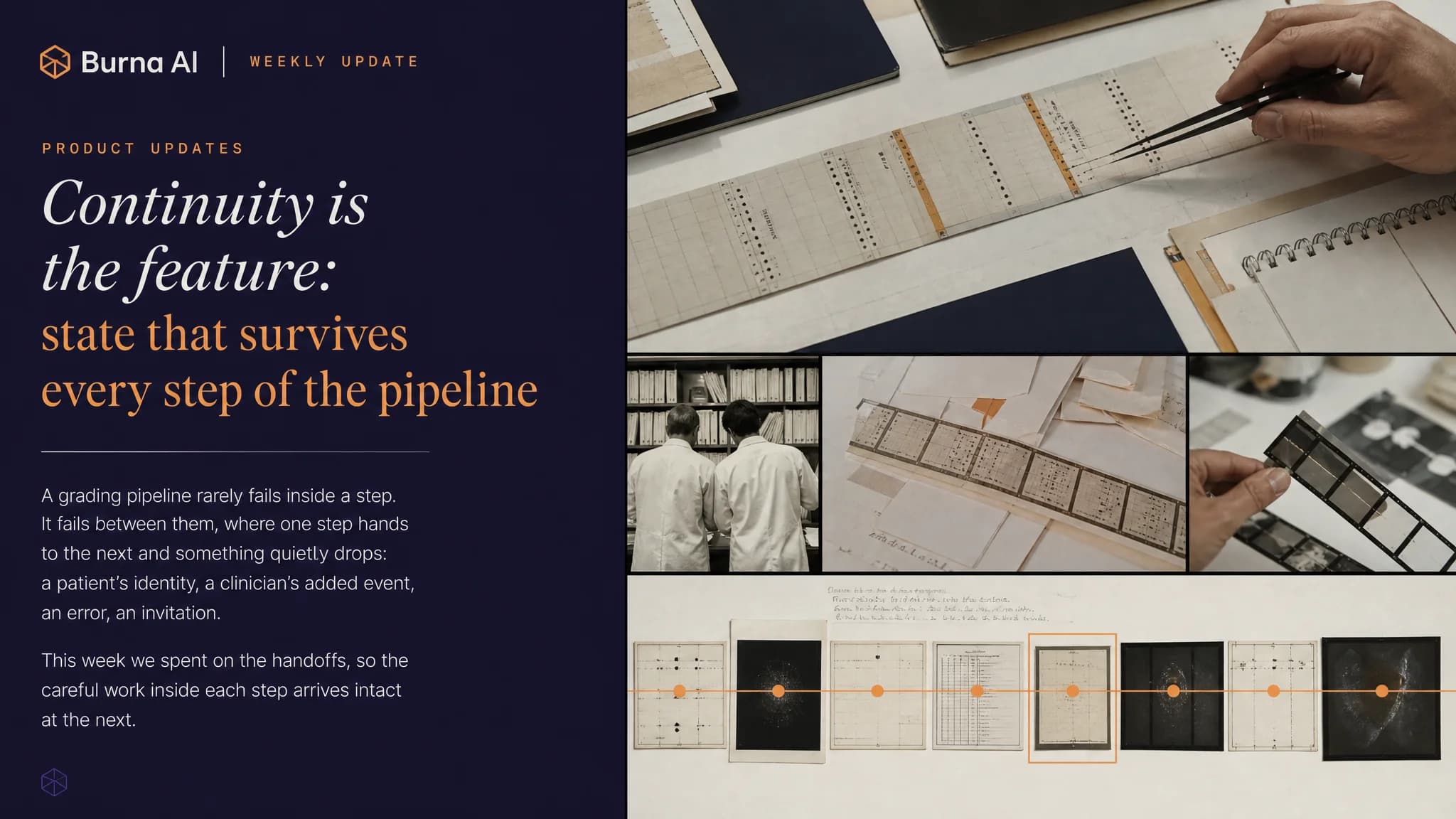
The Burna AI patient context pipeline carries one patient's clinical note through CTCAE grading, drug attribution, interaction screening, clinician review and sign-off as a single connected record, so every step works on the same patient and the same visit. The work below was built on a development branch in July 2026 and went live on the platform on 10 August 2026, when it merged as one release. It serves the coordinators and investigators who grade adverse events for the same patients, visit after visit.
How the Burna AI patient context pipeline works
- A clinician attaches a note to a patient and a visit.
- CTCAE grading runs on the note, and each grade carries its criterion and the line in the note that produced it.
- When grading completes, drug attribution and interaction screening start in parallel, each linked to the grading run that produced its input.
- The clinician accepts, edits or dismisses each grade.
- A qualified investigator signs the reviewed findings.
That chain, note to sign-off, now runs end to end on the platform, checked against the stored record at every step rather than against the screen. Inside step 2, twelve specialized agents in a cascading constraint pipeline do the grading work.
A reload resumes the same grading runs
Each run's progress is stored as it happens. When a clinician reloads an encounter, the page restores the grading, attribution and interaction runs from that stored record and carries on from where they stand, instead of starting new ones.
- Three reloads of one encounter in testing produced two follow-on runs, one attribution and one interaction screen. A restart on every reload would have produced eight.
- A cold reload rebuilt every completed step, with its grade and citation, from the stored output alone.
The patient dialog keeps the grade you queued
Grading waits until a note is attached to a patient. Choosing a patient and continuing, and closing the dialog to abandon the step, are now two separate outcomes. A clinician who picks the patient and carries on keeps the grade already queued for that note.
Review reads exactly what each run wrote
After every grading run, the graded events are written to the visit itself, and the review pane reads that record. Drug attribution and drug interaction results are read from the saved output of the runs that produced them, and each of those two reads is scoped to the organization and recorded in the audit trail.
The result: reopening an encounter shows the same grades and the same attribution the clinician reviewed, and the next person to open it sees the same record.
Since then (18 August 2026): the running and review views of a completed grading run became one review pane over the same saved record.
A longitudinal adverse event record, fed after every run
Copy-forward detection now runs after every CTCAE grading run on the platform. It flags the patterns that suggest a grade was carried from an earlier note rather than reassessed:
| Signal | What it looks for |
|---|---|
| Identical grade | The same grade for the same event, visit after visit |
| Repeated evidence | Evidence text copied word for word from an earlier note |
| Implausible timing | Timing that does not fit the course of the event |
Each run also adds its findings, with their citations, to the patient's longitudinal adverse event record. That history is what the next visit's check reads, so a stale grade is judged against the patient's trajectory rather than a single note. How copy-forward detection works covers the three checks and what the clinician decides.
Workspace invitations that open before sign-in
An invitation email is often a person's first contact with the platform, so the invitation page now opens before sign-in. Accepting the invitation switches the person into the workspace that invited them, so a new coordinator's first screen is their team's.
Since then (13 August 2026): invitation emails link to the web app's own address, so the link in the email opens the acceptance page directly.
Where this runs today
The 10 August release also retired the earlier provider web app; the platform runs at app.burna.ai. For every capability that is live now, see what Burna AI does today.
AI suggests, clinicians decide. Human-in-the-loop, always.
If your team grades adverse events for the same patients across many visits, book a 15-minute conversation.