
PRODUCT UPDATES · JAN 23, 2026 · 3 MIN READ
Multi-event CTCAE grading in one session, and CTCAE term search on the web
Week 4 of 2026: an encounter screen that grades every adverse event in a note in one run, beside the note, with drug attribution on the next tab, and a CTCAE v6.0 term search on the web.
Burna AI Team
What shipped in Week 4, 2026
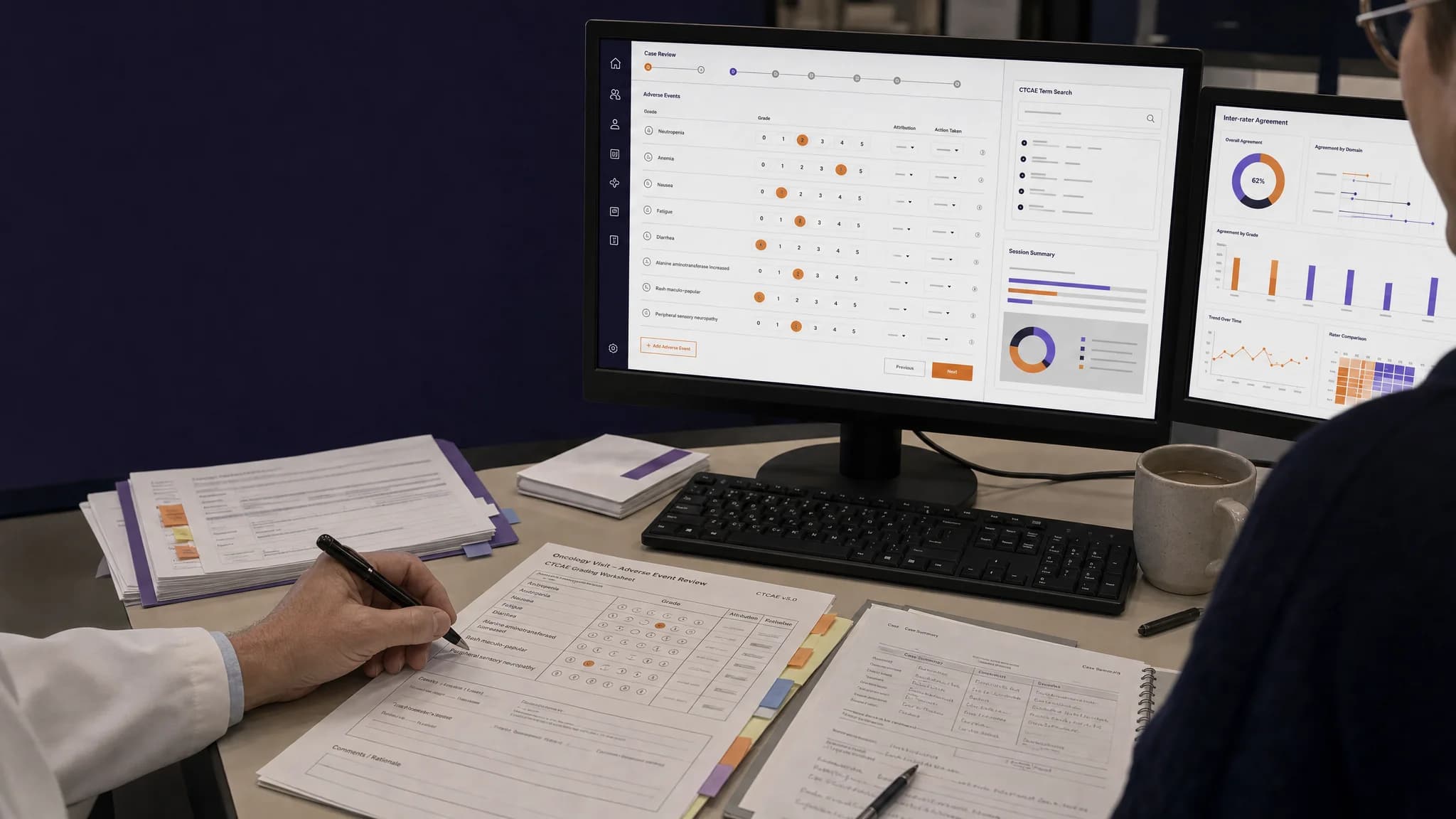
Multi-event CTCAE grading means one grading run reads a clinical note and grades every adverse event it documents, each with its own grade, rationale, evidence and confidence. Between January 19 and 25, 2026, the web provider dashboard gained an encounter screen that runs that grading beside the note itself, with drug attribution on the next tab, and a redesigned CTCAE term search. Coordinators and investigators reviewing a patient with several concurrent adverse events now see them together, in the context of the note that documents them.
What multi-event CTCAE grading is, and why it matters
Patients on combination regimens often present with several adverse events at a single visit: fatigue, nausea and a falling blood count can all sit in one note. Grading them one at a time means opening the same note again for each event and carrying the context across by memory.
In a multi-event run, every event is graded from the same reading of the note, so concurrent symptoms and the regimen stay in view while each grade is set. Each event still receives its own CTCAE grade, rationale, supporting evidence and confidence score, and each carries its own review status. The single-event grading path was retired on January 17, and this week's encounter screen brings the multi-event output to the web dashboard. How many adverse events Burna AI grades from one note covers the platform as it runs today.
The encounter screen: the note on the left, grading on the right
The encounter screen, live from January 21, puts the note on the left and the grading work on the right:
| Area | What it shows |
|---|---|
| Clinical note | The note, broken into collapsible Subjective, Objective, Assessment and Plan sections |
| CTCAE grading | The grading run, step by step as it works, then every graded event from the note |
| Drug attribution | The attribution analysis for each event against the drugs in the regimen |
| Patient | A sidebar to assign the encounter to a patient by searching existing patients or creating one |
The dashboard home lists visits with search and status filters, and a new encounter starts from a pasted clinical note, a recording or an attached file.
CTCAE term search on the web
The same release, on January 21, rebuilt CTCAE term search for the web dashboard:
- Search runs against the CTCAE v6.0 term set, and each result opens to its grade definitions.
- A grade reference panel sits beside the results on larger screens.
- Every result cites its source as CTCAE v6.0, published by NCI in July 2025.
- Each result also suggested matching ICD-10 codes (see Since then).
- Results export to JSON or CSV, or copy to the clipboard.
- Search opens from the command palette with Cmd+K.
For a quick lookup outside the platform, every CTCAE v6.0 term on ctcae.ai is free to browse.
Where inter-rater agreement fits
Consistency is the question a quality reviewer asks of any grading process, AI-assisted or manual. In a published study of 100 on-treatment radiation oncology notes, two reviewers identifying CTCAE adverse events agreed at kappa 0.59 to 0.68 (Fairchild, Hong and colleagues, 2020), which is why agreement measurement sits beside grading in the platform.
The grading analytics dashboard began reading live grading data on February 19 and 20, 2026. Today, blind grading lets several raters grade the same case without seeing each other's work, disagreements route to an adjudicator, and inter-rater agreement is measured. How Burna AI measures inter-rater reliability covers the statistics.
Settings and smaller changes
- On January 20, settings moved into one panel with sections for the profile, AI preferences, the organization and its members, documents and export history, integrations, and privacy, terms, FAQs and support.
- On the phone, the clinical evidence behind an adverse event became editable during review, so a reviewer can correct it in place.
- Mobile form fields stay clear of the on-screen keyboard, and creating a patient and assigning the visit to them works as one step.
- Uploads accept audio recorded in the M4A format used by many phones.
Since then
- ICD-10 suggestions beside CTCAE terms were removed on June 9, 2026. ICD-10 coding belongs downstream in billing, and codes beside CTCAE terms confused providers. Each adverse event carries a MedDRA lowest level term code, the terminology safety reporting uses.
- The web provider dashboard was later retired. The platform runs at app.burna.ai, where every adverse event in a note is graded against the CTCAE version the protocol names, v5.0 or v6.0. See CTCAE v5 and v6 grading with the criterion attached.
See it on your own workflow
To see multi-event CTCAE grading on your own notes, book a 15-minute conversation.