
CTCAE · OCT 2, 2026 · 8 MIN READ
CTCAE v6.0 migration guide, part 2: running v5.0 and v6.0 through the CTCAE version transition
During the CTCAE version transition, older clinical trials grade on v5.0 and newer ones on v6.0. How sponsors and sites keep every grade comparable.
Burna AI Team
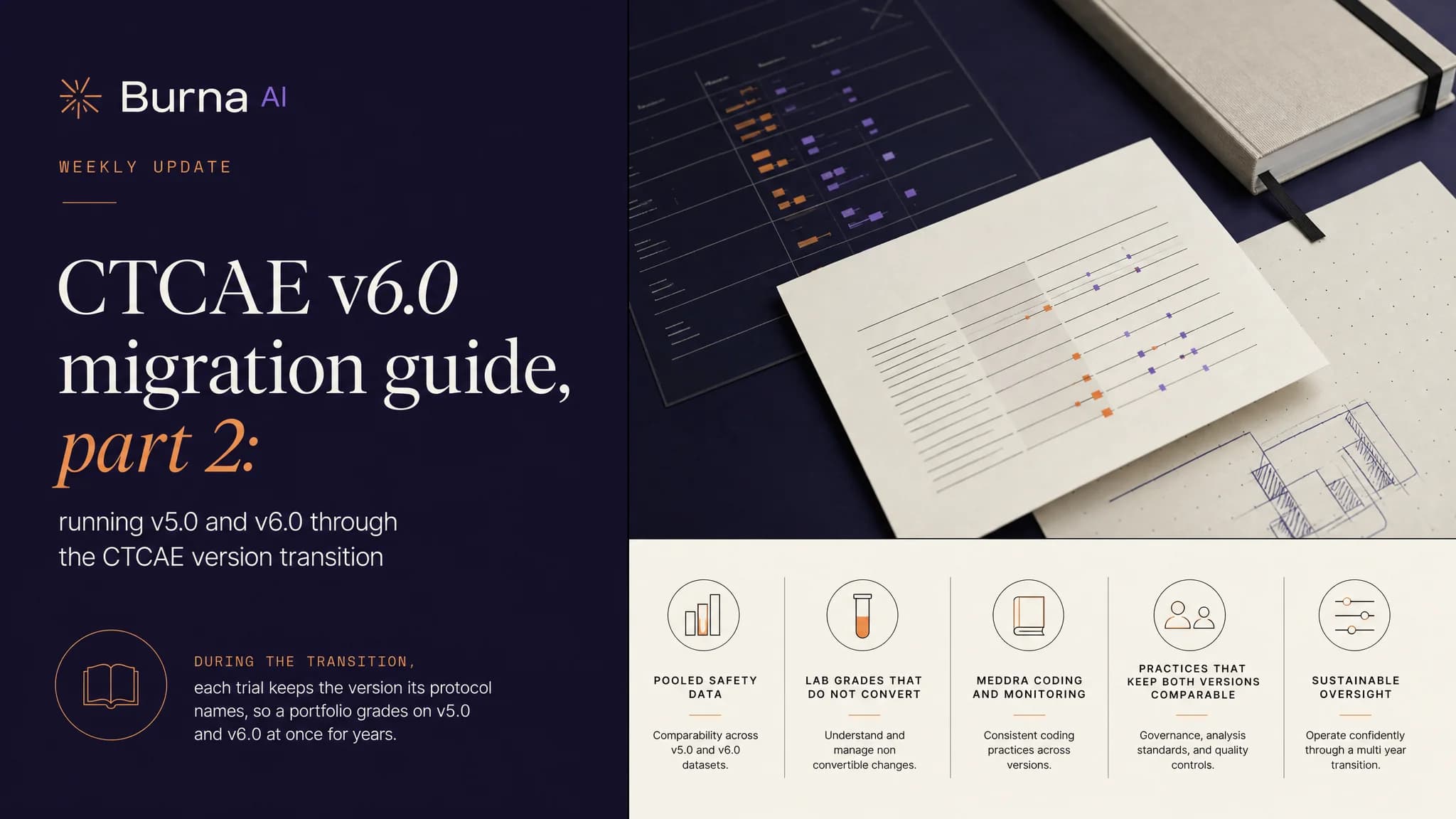
The CTCAE version transition is the period in which ongoing clinical trials keep grading on CTCAE v5.0 while new trials grade on v6.0, because each trial grades on the version its protocol names until the protocol is amended. A sponsor's portfolio and a site's trial list therefore run both versions at the same time for years. The operational task is to make every grade carry the version that produced it, so pooled safety tables, MedDRA coding and monitoring can tell a change in the vocabulary from a change in the patients.
For what changed term by term, start with part 1 of the CTCAE v6.0 migration guide, or look up every CTCAE v6.0 change, term by term. This part covers the operations.
In short:
- Record the version, the term, the MedDRA LLT code and the criterion applied on every graded event.
- Name the pooling target version in the statistical analysis plan, and re-derive lab grades from the lab values rather than from the grades.
How does the CTCAE version transition work in clinical trials?
NCI published CTCAE v6.0 on July 22, 2025, built on MedDRA 28.0; its predecessor, v5.0, was released in 2017 on MedDRA 20.1 (NCI CTEP adverse events page). NCI's CTCAE v6.0 implementation FAQ, dated September 9, 2025, takes three positions:
- v6.0 is ready for immediate use for any study except NCI CTEP or DCP NCORP studies, and questions about a specific study go to its sponsor.
- NCI CTEP and DCP studies already on v5.0 stay on v5.0 for the life of the study, and NCI does not require their data to be converted.
- New NCI CTEP and DCP studies use v6.0 once their Rave study build begins after the CTCAE v6.0 Rave ALS (ALS 7.2, the Architect Loader Spreadsheet used for Rave study builds) is released. The FAQ gave July 2026 as a tentative date for that release; the CTEP adverse events page carries the current documents.
The result is a stratified portfolio: studies opened under v5.0 keep following patients under v5.0, new studies open under v6.0, and the same coordinator and safety team often handle both in one week. The overlap, not the release date, is the event to plan for.
Which CTCAE version should my trial use?
A trial grades against the CTCAE version its protocol names, and keeps it until the sponsor amends the protocol. The common cases:
| Situation | Grade against | Basis |
|---|---|---|
| Ongoing study whose protocol names v5.0 | v5.0, for the life of the study unless the sponsor amends | The protocol; NCI CTEP and DCP studies reporting in v5.0 stay on v5.0 for the life of the study |
| New industry or investigator-sponsored study | The version the protocol names; v6.0 is available now | NCI FAQ: v6.0 is ready for immediate use outside NCI CTEP and DCP NCORP studies; ask the study sponsor |
| New NCI CTEP or DCP study | v6.0, once its Rave study build begins after ALS 7.2 is released | NCI FAQ |
| One of the eight v6.0 terms with a named v5.0 substitute, on a v5.0 study | The v5.0 substitute term | For example, Diabetes mellitus is recorded as Hyperglycemia |
| Left ventricular dysfunction, on a v5.0 study | Ejection fraction decreased at grade 2; Left ventricular systolic dysfunction at grade 3 or higher | Counted among the 45 new v6.0 terms; the v5.0 term depends on the grade |
| Study amended from v5.0 to v6.0 | As the amendment specifies, with the version on every event | Earlier grades stay as graded |
Amending an open study to a new grading scale splits its safety data at each site's implementation date. For its own CTEP and DCP studies, NCI keeps v5.0 for the life of the study and requires no data conversion.
Which v5.0 and v6.0 differences break a pooled safety table?
CTCAE v6.0 has 850 terms: 45 new, 7 renamed, and 376 reworded at one grade or more since v5.0. Part 1 sets out the full v5.0 to v6.0 delta, and ctcae.ai, the free CTCAE lookup Burna AI built, lists every change term by term, counted by comparing NCI's v5.0 and v6.0 term lists. Three kinds of difference break a pooled table.
Same name, moved cutoff. Neutrophil count decreased keeps its name, organ system class and MedDRA code, but every band moved. Platelets moved at grades 3 and 4 under a new name. The count bands, from NCI's v5.0 and v6.0 criteria:
| Grade | Neutrophil count decreased, v5.0 | Neutrophil count decreased, v6.0 | Platelet count decreased, v5.0 | Thrombocytopenia, v6.0 |
|---|---|---|---|---|
| 1 | <LLN - 1500/mm3 | <1500 - 1000/mm3 | <LLN - 75,000/mm3 | <LLN - 75,000/mm3 |
| 2 | <1500 - 1000/mm3 | <1000 - 500/mm3 | <75,000 - 50,000/mm3 | <75,000 - 50,000/mm3 |
| 3 | <1000 - 500/mm3 | <500 - 100/mm3 | <50,000 - 25,000/mm3 | <50,000 - 10,000/mm3; transfusion indicated |
| 4 | <500/mm3 | <100/mm3 | <25,000/mm3 | <10,000/mm3; life-threatening consequences; urgent intervention indicated |
A grade 3 count pooled across both versions mixes two definitions under one label, and nothing in the term name says so. A grade alone does not always convert either. A neutrophil count from the lower limit of normal down to 1,500/mm3 is grade 1 in v5.0 and is not graded in v6.0. A v5.0 grade 4 count, below 500/mm3, is grade 3 or grade 4 in v6.0 depending on whether it is above or below 100/mm3. Platelets split the same way at 10,000/mm3. Only the lab value settles it.
Renamed, recoded and moved. v5.0's Platelet count decreased (MedDRA LLT 10035528, Investigations) is v6.0's Thrombocytopenia (LLT 10043554, Blood and lymphatic system disorders). A count of 20,000/mm3 is grade 4 in v5.0 and grade 3 in v6.0, and a summary table rolled up by organ system class files the same platelet events under different classes depending on each study's version.
Lymphocytes break harder. v5.0's Lymphocyte count decreased graded the count at grades 1 to 4, with cutoffs at 800, 500 and 200/mm3. v6.0's Lymphopenia has one grade, grade 1, "Present". A pooled grade 3 or higher lymphocyte row therefore exists only on v5.0 studies, and any comparison across versions has to start from the lab value.
One-directional substitutions. A v5.0 study records v6.0's Diabetes mellitus as Hyperglycemia, and Hemolytic anemia as Hemolysis. These run only from the v6.0 event to the v5.0 record, because Hyperglycemia also exists in v6.0 with its own definition: v6.0 grades it on glucose values (fasting at grades 1 and 2), v5.0 on the medical intervention it needed. On a v5.0 study a Hyperglycemia record can be a hyperglycemia event or a substituted diabetes event, and the coded term cannot say which. Keep the verbatim term so the pooling programmer can tell them apart.
Four of the eight substitutions (Tubulointerstitial nephritis, Hepatitis, Graft versus host disease and Thyroiditis) have no comparable v5.0 term at all, so a v5.0 study records them under that organ system's "Other, specify" term. There the specify text is the only field that identifies the event: make it mandatory in the CRF completion guidelines, and map from it when pooling. The seven renames and what v5.0 still records walks through each pair.
Why does every grade need to carry its CTCAE version?
Pooled safety analyses. Once data leaves its study, the version cannot be recovered from anything else, and a shift in the share of grade 3 events has two candidate explanations: the patients or the vocabulary. Study A grades on v5.0 and Study B on v6.0, and each records a patient with an ANC of 800/mm3. Study A reports grade 3 and Study B grade 2, so a pooled "grade 3 or higher" row counts one patient where two had the same count.
NCI's implementation FAQ says that where data must be consolidated into one version, for regulatory reporting or an aggregate analysis, NCI's mapping resource aligns all v5.0 term and grade combinations with their v6.0 terms and grades. The v6.0 Excel file on the NCI CTEP adverse events page includes a mapping to v5.0. Where one v5.0 grade spans two v6.0 grades or drops out of grading, as with the neutrophil and platelet rows above, the lab value decides rather than the mapping row. A mapping can only run on records that state the version they started in.
MedDRA coding. Each CTCAE v6.0 term is a MedDRA v28.0 LLT, and the seven renamed terms carry a different LLT code in each version. FDA's Study Data Technical Conformance Guide (June 2026, section 6.1.4, MedDRA) expects each study to use the MedDRA version current at study start, and does not require earlier studies to be recoded. For an integrated summary of safety, it asks that the adverse event dataset use MedDRA terms from the version current when the studies are pooled, because reviewers often analyze adverse events across studies, including with Standardized MedDRA Queries.
That pooling step is where a v5.0 code and a v6.0 code for the same platelet event meet, and the CTCAE version on each record tells the programmer which mapping applies. MedDRA coding consistency and signal detection covers the coding side.
Monitoring and source verification. A monitor checking a grade against source needs the criterion text in force when the event was graded. If the version lives only in the protocol, an amendment leaves every earlier record open to question. If a system looks criteria up when a record is read rather than storing what it applied, every grade made under an earlier version is shown beside criteria it was not graded under.
Cross-site consistency. Sites often implement an amendment on different dates, so a study moving from v5.0 to v6.0 holds both versions for a period. With the version on every event, a difference in grade distribution between sites is checked against the version first.
How do sponsors and sites keep v5.0 and v6.0 data comparable?
Six practices keep v5.0 and v6.0 data comparable:
- Record the version on every graded event, not only in the protocol or the study build, with its source: the protocol version or amendment that named it.
- Keep what was graded. Store the original verbatim term, grade, LLT code, the criterion text as applied and the source sentence it rests on, so the record answers a monitor's question by itself. For lab-based terms, keep the value and its unit, so the grade can be re-derived under the pooling target. Map to a single version in the analysis datasets, never by overwriting the record.
- Read substitutions one way. A v6.0 event becomes a v5.0 record through the substitution list; a v5.0 record does not turn back into a v6.0 event the same way.
- Name the moved cutoffs in training and monitoring plans. Lab terms such as Neutrophil count decreased, Thrombocytopenia and Lymphopenia are where the same value lands on different grades, or on none.
- Fix the pooling target before pooling. Name the target CTCAE version and MedDRA version in the statistical analysis plan, and start from NCI's v5.0 to v6.0 mapping resource. Check how the mapping treats the lab rows whose grades split or drop out before relying on it.
- Store the version as an open value. A field that accepts any published version, rather than a two-value v5/v6 flag, takes CTCAE v7.0 as a new value instead of a schema change.
Three questions for any grading system during the overlap
- Where does the version live: on the study, or on each graded event?
- What happens to a term whose name stayed and whose cutoff moved? A system that resolves by name alone matches confidently and grades against the wrong threshold.
- Can a grade from two years ago be shown with the criterion text that applied when it was graded?
How Burna AI grades a portfolio on both versions
On a trial, Burna AI grades every adverse event in a note against the CTCAE version the trial names, with v5.0 and v6.0 live on one engine (CTCAE v5 and v6 grading with the criterion attached). A clinician's explicit choice of version takes precedence, and with neither, the platform default applies. Every graded event stores the version that produced it and which of the three set it. Each grade traces to the line in the medical record that produced it and to the CTCAE criterion applied, and carries its MedDRA LLT code. AI suggests, clinicians decide: a grade becomes a record when a qualified investigator signs it with a 21 CFR Part 11 electronic signature. The short answer on coverage is in which CTCAE versions Burna AI supports.
Common questions about the CTCAE version transition
Can one clinical trial use both CTCAE v5.0 and v6.0?
Yes, across an amendment: a protocol names one version at a time, but a study amended from v5.0 to v6.0 holds grades under both, sometimes in the same week at different sites. Each grade then needs its version on the record, and an analysis that needs one version maps the other with NCI's mapping resource.
Do ongoing studies have to convert v5.0 data to v6.0?
NCI CTEP and DCP studies do not: NCI's implementation FAQ says they continue reporting in v5.0 for the life of the study, with no conversion required. For other studies the sponsor decides, and the decision belongs in the statistical analysis plan of any pooled analysis.
When will CTCAE v7.0 be released?
NCI's September 2025 implementation FAQ says v7.0 is expected to be developed and released between 2027 and 2030. A portfolio that records the version on every graded event handles that overlap the same way it handles the v5.0 to v6.0 one.
Running a portfolio that grades on both CTCAE versions? Book a 15-minute conversation.