
CLINICAL OPERATIONS · OCT 2, 2026 · 9 MIN READ
Source data verification for adverse events at a monitoring visit
Source data verification on an adverse event: what a monitor ties back to source for each field, and how risk-based monitoring decides how much to verify.
Burna AI Team
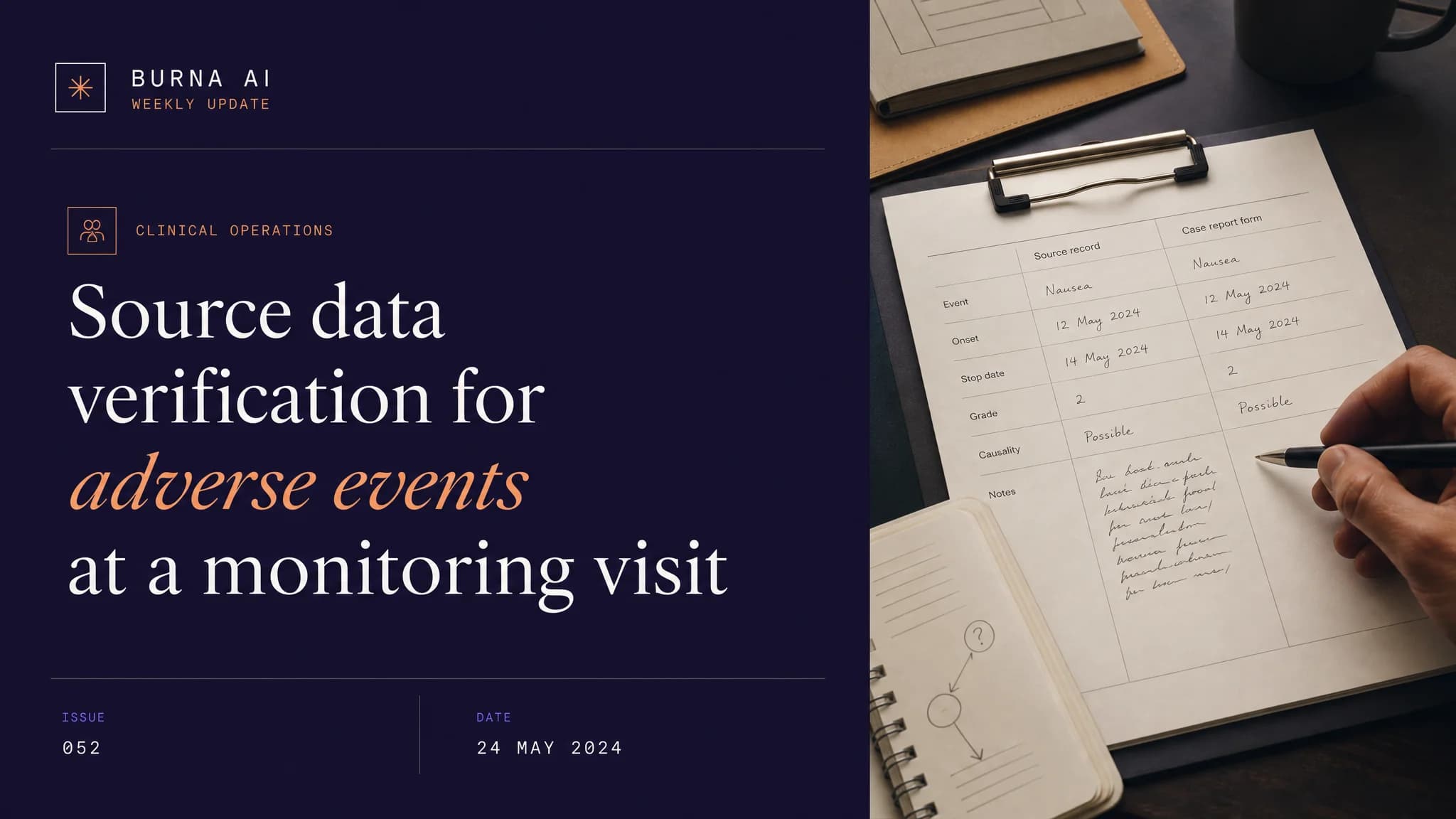
Source data verification (SDV), also called source document verification, is the monitoring check that compares the data in a case report form with the source record it came from, to confirm the data were transcribed accurately. On an adverse event, that means tying each field (term, grade, onset and stop dates, seriousness, action taken, outcome and causality, also called attribution) back to the progress note, lab result or chart entry that supports it. Under risk-based monitoring (FDA, 2013), the sponsor decides how much source data verification a study needs and where to aim it.
For a contract research organization (CRO), SDV is a cost line in every bid. An empirical comparison in a cancer trial described it as "a resource intensive method of quality assurance" (Tudur Smith et al., PLoS One, 2012). On the adverse event log, the expensive part is the query a comparison alone cannot close.
What is source data verification (SDV) in clinical research?
Source data verification (SDV) in clinical research is transcription checking: data in the case report form (CRF) are compared with the original source to confirm they were transcribed accurately, as TransCelerate's risk-based monitoring glossary defines it. FDA's 2023 guidance on risk-based monitoring describes it as confirming that the data in a study's analyses reflect the source data obtained during the investigation.
The source is defined in ICH E6(R3), the good clinical practice guideline adopted on January 6, 2025: original documents or data, or certified copies, including participants' medical records, notes and charts (glossary, page 77). Section 2.12.2 (page 21) asks that they be attributable, legible, contemporaneous, original, accurate and complete, and a BIMO inspection of adverse event records checks source against most of the same attributes. Under 21 CFR 312.62(b), case histories include progress notes, the hospital chart and nurses' notes, so for most adverse events the source is prose.
Source data verification vs source data review
Source data verification compares each CRF value with the source record; source data review examines the source itself, with no CRF comparison, for documentation quality, protocol compliance and investigator oversight. ICH E6(R3) section 3.11.4 (page 30) lists both among the approaches monitoring can use.
| Activity | What it compares or reviews | What it finds |
|---|---|---|
| Source data verification (SDV) | Each CRF value against the source record | Transcription errors: a grade, date or outcome that differs between note and form |
| Source data review (SDR) | The source itself, with no CRF comparison | Inadequate documentation, protocol noncompliance, gaps in investigator oversight |
| Centralized monitoring | Accumulated data, evaluated by the sponsor's qualified staff, such as a medical monitor, data manager or biostatistician | Missing or inconsistent data, outliers, site-specific patterns |
TransCelerate describes SDR as necessary for areas that have no associated data field in the CRF. On an adverse event, SDV asks whether "Grade 3" in the form matches the note. SDR asks whether the note documents enough to support Grade 3 at all. The expensive findings sit in the second question. Some start upstream: a protocol silent or self-contradicting on its seriousness definition leaves every site documenting against that ambiguity, which a free protocol conformance report flags.
How does risk-based monitoring decide how much SDV to do?
Risk-based monitoring in clinical trials sets the extent of SDV from the sponsor's risk assessment, and four primary sources frame it:
- ICH E6(R3), section 3.11.4 (page 31). The sponsor "should determine the appropriate extent and nature of monitoring based on identified risks." Under section 3.11.4.5.4 (page 34), checking data against source "can be done on the basis of using samples and supported by data analytics," with data of higher criticality in the monitoring plan verified.
- FDA, Oversight of Clinical Investigations: A Risk-Based Approach to Monitoring (August 2013). For a particular study, "there may be minimal benefit in comparing 100% of the source data" with the CRFs (page 10). Its list of critical data and processes (page 11) includes protocol-required safety assessments and the evaluation, documentation and reporting of serious adverse events.
- FDA, A Risk-Based Approach to Monitoring of Clinical Investigations: Questions and Answers (April 2023). The extent of SDV "should be guided by the sponsor's risk assessment process and focused on critical study data and processes" (page 6).
- TransCelerate (Sheetz et al., Ther Innov Regul Sci, 2014). A literature review, a retrospective data analysis and member audit findings supported the conclusion that generalized SDV has limited value as a quality control measure. A later paper summarizes its central figure: a median of 1.1% of the total eCRF data in 1,168 phase I to IV studies from 53 sponsors was corrected by SDV (Kondo et al., Ther Innov Regul Sci, 2021).
Because serious adverse event reporting sits on FDA's critical list, a plan that samples other data lightly still keeps serious adverse events, and events the protocol designates as critical, in close scope. The monitoring plan sets how much of the rest is verified.
What does a monitor check on an adverse event record?
An adverse event review at a monitoring visit usually runs in this order:
- Pull the listing. The adverse event log from the electronic data capture (EDC) system, for the participants and visits the monitoring plan selects.
- Open the source. The note, lab result or chart entry behind each event, on site or through remote read-only access.
- Compare and review. Each CRF field against that source (SDV), and the source for whether it supports the value at all (SDR).
- Check the timing. Were events reported within the time periods the protocol, good clinical practice and applicable regulations require (ICH E6(R3) section 3.11.4.5.2, page 33). Under section 2.7.2 (pages 14 to 15), serious adverse events go to the sponsor immediately, except those the protocol identifies as not needing immediate reporting, with the investigator's assessment of causality.
- Query and close. Each mismatch or unsupported value becomes an EDC query; the site corrects the form traceably or explains the discrepancy (section 2.12.6, page 22).
- Report. What was reviewed, the significant findings, the actions to resolve them and follow-up on findings left open earlier (section 3.11.4.6, page 34).
CRFs differ, but an adverse event log carries a recognizable set of fields, each needing support in source.
| Adverse event field | What the monitor confirms in source | A typical gap |
|---|---|---|
| Event term | The note describes an event that maps to a term in the Common Terminology Criteria for Adverse Events (CTCAE) version the protocol names | The symptom is described but never named |
| Grade | The documented finding meets that term's criterion text | The criterion needs a value the note leaves out, such as baseline |
| Onset and stop dates | A dated passage shows when the event began and resolved | A late-reported symptom took the visit date as its onset |
| Seriousness | A regulatory seriousness criterion is documented, apart from grade | An admission is recorded without its reason |
| Action taken with study drug | The investigator's decision about the regimen | A dose hold with no link to the event |
| Outcome | Resolution or ongoing status | An ongoing event is never closed |
| Causality | The investigator's assessment for each suspect drug, and its basis | A relatedness box ticked with no reasoning, in a multi-drug regimen |
Why do some adverse event queries take longer to close?
Adverse event queries take longest when the form records a judgment, such as a grade, an onset date or a causality call, whose reasoning never reached the source note. The site then has to retrieve the chart and re-derive it. Of the two kinds of finding, only one is cheap.
A transcription finding is a mismatch: the form says Grade 3 and the note supports Grade 2, or the stop date is a day off. The monitor raises a query, the site corrects the form and the query closes.
A judgment finding is different in kind. The form records a determination, and the source does not carry the reasoning behind it. Take diarrhea: in both CTCAE v5.0 and v6.0, Grade 2 includes an increase of 4 to 6 stools per day over baseline and Grade 3 an increase of 7 or more (NCI CTCAE; Diarrhea in both versions on ctcae.ai). A note that records eight stools a day without the patient's baseline supports, on the stool-count criterion alone, Grade 3 if baseline was one a day and Grade 2 if it was two. The value in the form may be right. The evidence a second reader needs to confirm it is not in the record.
Qualified readers diverge on exactly these fields. Two observers reviewing the same records of patients on immune checkpoint inhibitors showed limited or poor agreement on whether most immune-related adverse events occurred and on their grade, and their onset dates differed by 5 to 188 days (Hsiehchen et al., JAMA Network Open, 2019). They agreed almost completely on when immunotherapy started and stopped, so the authors attributed the differences largely to interpretation, not identification.
Comparison cannot settle a judgment finding. Closing one takes a person at the site to retrieve the chart and re-derive a determination made at an encounter that may be weeks old, and that round trip is the cost.
What makes an adverse event record verifiable in one pass?
The evidence for each field has to be produced with the field, from the same reading of the same note, rather than reassembled later by a monitor working backward from the form. ICH E6(R3) section 3.11.4.5.4 (page 34) asks monitoring to check "the accuracy, completeness and consistency of the reported trial data against the source records," and section 2.12.2 asks that unnecessary transcription steps between source and the data acquisition tool be avoided.
Whatever system a site uses, a source note supports its adverse event entry in one pass when it carries:
- the baseline value the grade's criterion is measured against;
- the finding that sets the grade, in the criterion's own terms (a count, a lab value, a limit on activities of daily living);
- a dated passage for onset and for resolution;
- the reason for any admission, so seriousness can be read apart from grade;
- the event a dose hold or reduction was tied to;
- the investigator's causality reasoning for each suspect drug.
In Burna AI (grading, attribution, the signature and export are on the capabilities record):
- The grade carries its evidence. Every adverse event in a note is graded against the CTCAE version the protocol names, v5.0 or v6.0. Every grade traces to the line in the medical record that produced it, and a grade whose citation set is incomplete is flagged before it is signed.
- Causality carries its working. Each event is scored for causality against every drug in the regimen using the WHO-UMC and Kramer algorithms, with the reasoning shown.
- The signature fixes what was accepted. A grade becomes a record when a qualified investigator signs it with a 21 CFR Part 11 electronic signature, and the signature carries what was accepted, what was overridden and the citation set as signed. AI suggests, clinicians decide. Human-in-the-loop, always.
- The monitor reads the same record. The graded record exports for a sponsor or a monitor, every access to patient data is recorded, and the coordinator can file the adverse event log entry in Medidata Rave from it after reviewing and signing.
A monitor working from that record is verifying rather than reconstructing: the question changes from "what was the investigator thinking?" to "does this passage support this value?", which is answered in place, during the visit.
Three questions to ask before the first monitoring visit
For a CRO the cost argument follows from that distinction. Every query costs the monitor time to raise and the site time to answer. An entry that arrives with its support leaves less to ask, and what remains leans toward transcription queries that close in one exchange, which is work a bid can forecast; that is the basis of how Burna AI works for CROs. Three questions test a record before the visit:
- Is the causality reasoning in the note for each suspect drug? A coordinator can check before the visit that the investigator's basis is written down for every drug in the regimen. A code alone makes the check a reconstruction; per-drug reasoning makes it a comparison.
- Does the note carry every value the grade's criterion needs? Read the criterion text, then find each value it depends on in the note, baseline included. A missing value is a query the site can answer now.
- What would a difference between sites look like on the adverse event listing? If one site grades an event a grade higher, or attributes it to the backbone chemotherapy rather than the investigational agent added to it, the listing shows only the values. Cited evidence shows the reason, so a monitor can tell a documentation gap from a difference in judgment.
Source data verification: frequently asked questions
Is 100% source data verification required?
No, not under FDA or ICH guidance. FDA's 2013 guidance states that risk-based monitoring can meet statutory and regulatory requirements under appropriate circumstances, and that a study may gain minimal benefit from verifying 100% of source data. ICH E6(R3) allows checks against source by sampling, supported by data analytics, so the monitoring plan sets the extent.
Is source document verification the same as source data verification?
The terms are used interchangeably in practice. FDA's 2013 monitoring guidance titles section III.B.3 (page 10) "Source Data Verification and Corroboration" and uses "source document verification" within it. Source data review is the distinct activity, a review of the source itself with no comparison to the CRF.
Can source data verification be done remotely?
Yes, where the monitoring plan provides for it. ICH E6(R3) section 3.11.4.1 (page 31) says site monitoring may be performed on site and/or remotely, and may include remote and secure, direct read-only access to source records.
Pricing the monitoring line on a multi-site oncology bid, with adverse event queries as the number to move? See a note become a graded, attributed record with its source line attached. Book a 15-minute conversation.