
ATTRIBUTION AND CAUSALITY · OCT 2, 2026 · 9 MIN READ
The Naranjo scale, WHO-UMC and Kramer: three ways to judge whether a drug caused an adverse event
The Naranjo scale scores ten questions to judge whether a drug caused an adverse event. How it compares with WHO-UMC and Kramer, and where each fits.
Burna AI Team
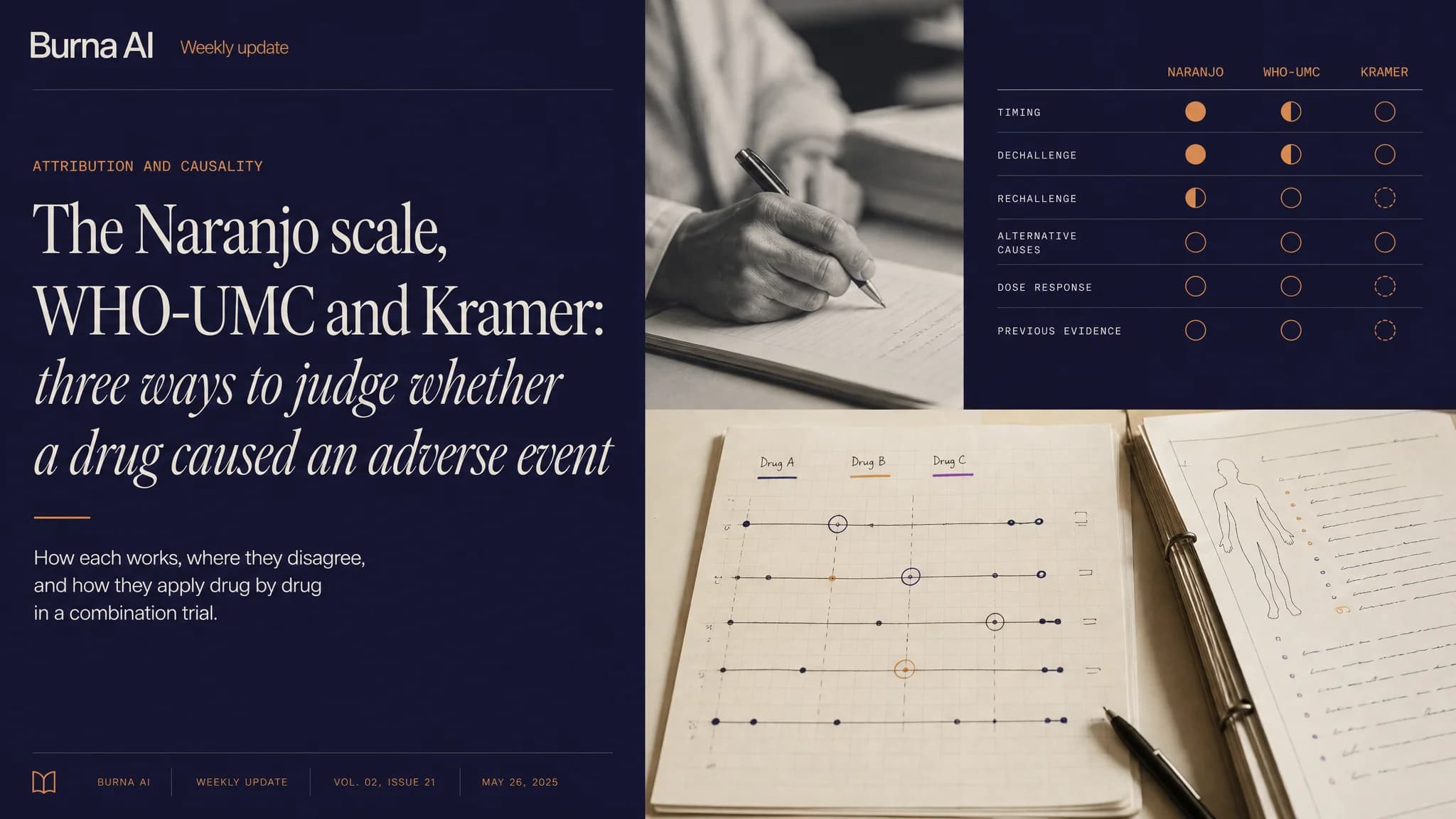
The Naranjo scale is a ten-question scoring tool, published by Naranjo and colleagues in 1981, that estimates how likely it is that a drug caused an adverse event (Naranjo et al., Clinical Pharmacology & Therapeutics, 1981). A total of 9 or more is definite, 5 to 8 probable, 1 to 4 possible, and 0 or less doubtful.
The WHO-UMC system reaches a category by testing the case against written criteria instead of adding points, and the Kramer algorithm scores six axes of evidence. All three ask about timing, withdrawal, re-exposure and alternative causes; they weigh those facts differently, so one case can land in different categories.
For a sponsor, the choice of method reaches the label. FDA's labeling rule admits an event to the Adverse Reactions section only when there is "some basis to believe there is a causal relationship" with the drug, and it describes the adverse reaction profile "based on the entire safety database" (21 CFR 201.57(c)(7)). Aggregate comparisons across that database are part of the basis, and so is the attribution recorded case by case during the trial. A named method, applied the same way to every case, helps elucidate the safety profile the label will carry.
Naranjo vs WHO-UMC vs Kramer: the short answer
Naranjo and Kramer add up points, while WHO-UMC tests the case against written criteria and keeps separate categories for cases that cannot yet be judged.
| Naranjo scale | WHO-UMC system | Kramer algorithm | |
|---|---|---|---|
| Published | Naranjo et al., Clinical Pharmacology & Therapeutics, 1981 | Uppsala Monitoring Centre, with the national centers of the WHO Programme for International Drug Monitoring (undated WHO-UMC guidance) | Kramer et al., JAMA, 1979 |
| How it decides | Ten questions, each scored; the points are summed | Written criteria for each category; the assessor tests the case against them | Six axes, each scored; the points are summed |
| What it weighs | Previous reports, timing, dechallenge, rechallenge, alternative causes, placebo response, drug levels, dose-response, prior reaction, objective evidence | Time relationship, disease or other drugs as explanations, response to withdrawal, rechallenge, whether the event is a recognized drug phenomenon, quality of documentation | Previous experience with the drug, alternative causes, timing, drug levels and overdose, dechallenge, rechallenge |
| Categories | Definite, Probable, Possible, Doubtful | Certain, Probable/Likely, Possible, Unlikely, Conditional/Unclassified, Unassessable/Unclassifiable | Definite, Probable, Possible, Unlikely |
| A case with gaps | An unanswered question scores 0 | Two categories of its own: Conditional and Unassessable | Falls into one of the four categories |
| What is already known about the drug | Earns points | Plays a deliberately smaller role | An axis of its own |
| Other drugs | Count as alternative causes and cost the suspect points; no question addresses an interaction | Named in the criteria; for an interaction, the actor drug is assessed | Scored as alternative candidates against the suspect |
Sources: Naranjo et al., 1981; The use of the WHO-UMC system for standardised case causality assessment; Kramer et al., JAMA, 1979.
How is the Naranjo scale scored?
The Naranjo adverse drug reaction probability scale asks ten questions about one suspect drug and one event. Each is answered Yes, No or Do not know, and each answer carries points:
| # | Question (paraphrased) | Yes | No | Do not know |
|---|---|---|---|---|
| 1 | Are there previous conclusive reports of this reaction? | +1 | 0 | 0 |
| 2 | Did the event appear after the suspect drug was given? | +2 | -1 | 0 |
| 3 | Did it improve when the drug was stopped, or a specific antagonist given? | +1 | 0 | 0 |
| 4 | Did it reappear when the drug was given again? | +2 | -1 | 0 |
| 5 | Could causes other than the drug have produced it on their own? | -1 | +2 | 0 |
| 6 | Did it reappear when a placebo was given? | -1 | +1 | 0 |
| 7 | Was the drug found in blood or other fluids at concentrations known to be toxic? | +1 | 0 | 0 |
| 8 | Was it worse at a higher dose, or milder at a lower one? | +1 | 0 | 0 |
| 9 | Has the patient reacted the same way to this or a similar drug before? | +1 | 0 | 0 |
| 10 | Was the event confirmed by objective evidence? | +1 | 0 | 0 |
The total runs from -4 to +13 and maps to four categories (Naranjo et al., 1981; Murali et al., PLOS ONE, 2021):
- 9 or more: definite
- 5 to 8: probable
- 1 to 4: possible
- 0 or less: doubtful
Three things to know before relying on the number:
- It is quick and reproducible. In a 1982 comparison by Naranjo's own group, two observers rated 63 cases with both the Naranjo scale and Kramer's longer algorithm. Agreement between the observers was very high on both, the two methods' scores correlated highly (r = 0.82), and Kramer's took longer (Busto et al., British Journal of Clinical Pharmacology, 1982).
- Several questions usually go unanswered. Across 1,676 reactions at a children's hospital, the questions on rechallenge, placebo, drug levels and dose change were answered "unknown" more than 85% of the time (Murali et al., 2021).
- A new drug has a ceiling. For a first-in-human agent, questions 1 and 9 usually score 0. When they do, and no rechallenge, placebo challenge or drug level exists, the highest reachable total is 7: probable. A definite call then needs a positive rechallenge (+2), or both a placebo challenge without recurrence and a drug level known to be toxic (+1 each). For a first-in-human agent, a concentration known to be toxic may not exist yet.
How does the WHO causality assessment scale (WHO-UMC) work?
The WHO-UMC system, the WHO causality assessment scale, is a practical tool for case reports that combines the clinical and pharmacological facts of a case with the quality of its documentation. Because pharmacovigilance looks for reactions nobody has described yet, previous knowledge plays a less prominent role than in the scoring methods. Each category comes with criteria that should all be reasonably met (WHO-UMC):
- Certain: a plausible time relationship; no explanation by disease or other drugs; a plausible response to withdrawal; an event that is pharmacologically or phenomenologically definitive (an objective, specific disorder or a recognized pharmacological phenomenon); and a satisfactory rechallenge, if needed.
- Probable / Likely: a reasonable time relationship; unlikely to be attributed to disease or other drugs; a clinically reasonable response to withdrawal; no rechallenge required.
- Possible: a reasonable time relationship, but disease or other drugs could also explain the event, and information on withdrawal may be missing or unclear.
- Unlikely: a time relationship that makes a causal link improbable but not impossible, with disease or other drugs offering plausible explanations.
- Conditional / Unclassified: more data is needed for a proper assessment, or is being examined.
- Unassessable / Unclassifiable: the information is insufficient or contradictory and cannot be supplemented or verified.
Three features matter in practice:
- Certain is reserved. An event that is not definitive in that sense can never reach it, even after a positive rechallenge.
- Assessors start in the middle. Most cases sit at Possible or Probable, so the assessor starts at one of them and moves one category up or down as the criteria fit.
- The method states its limits. Causality assessment cannot measure likelihood precisely, quantify a drug's contribution or prove the connection. It classifies the relationship and decreases disagreement between assessors.
The criteria lean on withdrawal and re-exposure, explained in what dechallenge and rechallenge mean. The two methods Burna AI applies are summarized in WHO-UMC and Kramer, explained.
The Kramer algorithm: six axes and a score
Kramer and colleagues published their algorithm in 1979 to give explicit criteria for a judgment that had rested on unstated clinical impression. It scores six axes (Kramer et al., JAMA, 1979):
- Previous general experience with the drug
- Alternative etiologic candidates
- Timing of events
- Drug levels and evidence of overdose
- Dechallenge
- Rechallenge
Each axis is scored, and the sum is partitioned into four ordered categories: definite, probable, possible and unlikely. Its companion paper tested it on 30 suspect cases. Pairwise agreement between two clinical pharmacology experts rose from 47% without the algorithm to 63% with it. The algorithm's three developers, who were not experts, agreed with expert consensus in 80% to 83% of cases when they used it (Hutchinson et al., JAMA, 1979).
Its cost is length: the 1982 head-to-head found conclusions very close to Naranjo's, reached more slowly. Its strength for trial work is the second axis, which turns every other candidate cause, including the other drugs in a regimen, into a scored question.
Where do the causality assessment scales disagree?
Head-to-head studies find the methods agree only in part. WHO-UMC and Naranjo agreed moderately, Cohen's kappa 0.45, across 230 cases at a hospital adverse drug reaction monitoring center in India (Behera et al., International Journal of Clinical Pharmacy, 2018). Raters disagreed about as much on one scale as on the other: when five raters each assessed the same 100 case reports with both, their agreement was slight for WHO-UMC (Fleiss kappa 0.2) and fair for Naranjo (0.297) (Pandit et al., Journal of Patient Safety, 2024). A systematic review counted 34 published methods and found none universally accepted (Agbabiaka et al., Drug Safety, 2008).
Oncology adds its own evidence: a recurring adverse event's attribution changes between visits for the same patient in 31 to 36% of cases (Hillman et al., JCO 2010), covered in adverse event attribution and the drug label.
The structural reasons are visible in the comparison table:
- Prior knowledge. Naranjo and Kramer give weight to what is already known about the drug. WHO-UMC deliberately gives it less, because pharmacovigilance is looking for reactions nobody has described yet. On Naranjo, a reaction nobody has reported before forgoes question 1's point; on Kramer, the same gap weighs on the first axis.
- Points versus criteria. On Naranjo, question 5 alone moves a total by three points: -1 if an alternative cause exists, +2 if none does. WHO-UMC asks how likely the alternative is, which is a judgment rather than a count.
- Gaps in the record. WHO-UMC has categories for a case that cannot yet be judged. Naranjo scores an unknown as 0, so a thin record tends to land at possible or doubtful, and the category does not say whether the facts or the gaps put it there.
Naranjo scale example: one case, three readings
A participant starts drug A. Three weeks later, alanine aminotransferase rises from a normal baseline to 8 times the upper limit of normal: grade 3 Alanine aminotransferase increased under both CTCAE v5.0 and v6.0. Drug A is held and the value returns to baseline within two weeks. It is not restarted. Liver metastases were documented at enrollment, transaminase elevation is a known reaction to drug A, and no drug level or placebo challenge exists.
| Naranjo question | Answer | Points |
|---|---|---|
| 1. Previous conclusive reports | Yes | +1 |
| 2. Appeared after the drug | Yes | +2 |
| 3. Improved on stopping | Yes | +1 |
| 4. Reappeared on rechallenge | Not done | 0 |
| 5. Alternative causes | Yes: liver metastases | -1 |
| 6. Reappeared on placebo | Not done | 0 |
| 7. Toxic drug level | Not measured | 0 |
| 8. Dose-response | Not known | 0 |
| 9. Similar reaction before | No | 0 |
| 10. Objective evidence | Yes: laboratory value | +1 |
| Total | 4: possible |
- Naranjo: possible. Had imaging at the time shown stable liver lesions, and the assessor answered No to question 5, it would score +2 and the total would be 7: probable.
- WHO-UMC: possible or probable. The time relationship is reasonable and the response to withdrawal is clinically reasonable, so the category turns on whether the metastases could equally explain the rise (Possible) or are an unlikely explanation (Probable).
- Kramer: the same fork. Three axes point toward drug A: previous experience with the drug (a known liver effect), timing (onset three weeks after the start) and dechallenge (return to baseline once it was held). The alternative-candidates axis points away, because of the metastases. The drug-level and rechallenge axes have nothing to score. The fact in dispute is the same as on the other two methods: how much weight the metastases carry on that second axis.
All three turn on one fact: what the record says about the alternative cause, written down when the event happened.
For suspected drug-induced liver injury specifically, there is also a liver-specific method, the Roussel Uclaf Causality Assessment Method, or RUCAM (NIH LiverTox).
Multi-drug trials: one assessment per suspect
Each method was built to weigh one drug against one event. In a combination regimen, each suspect drug is assessed in turn, with the others treated as alternative causes:
- Naranjo: if any co-administered drug could explain the event, question 5 scores -1 instead of +2, so each suspect in a combination can score three points lower than it would alone.
- WHO-UMC: other drugs are written into the criteria, and a drug-drug interaction is assessed through the actor drug, the one that changes the kinetics or dynamics of the other.
- Kramer: the alternative-candidates axis scores the other drugs explicitly against the suspect.
None of them divides an event between drugs, so two drugs in one regimen can both be Possible.
Whatever method a protocol names, the result is read for reporting as related or not related. NCI's attribution categories for its own INDs (Unrelated, Unlikely, Possible, Probable, Definite) count Possible, Probable and Definite as a suspected reasonable causal relationship (NCI CTEP, effective August 30, 2024). FDA's IND safety reporting rule asks whether there is a reasonable possibility the drug caused the event, meaning "evidence to suggest a causal relationship" (21 CFR 312.32(a)). For the full case, see attribution drug by drug in combination regimens.
How Burna AI shows its reasoning
Burna AI scores each adverse event for attribution against every drug in the regimen, using WHO-UMC and Kramer, with the reasoning shown: the algorithm, the result for each drug, the comorbidities and concomitant medications weighed, and the lines in the medical record the reasoning rests on. For a first-in-human agent, whose adverse event record is still to be written, Burna AI works from the protocol: it scores the established drugs in the regimen, and what they do not explain is weighed against the new agent. Every grade traces to the line in the medical record that produced it. See WHO-UMC and Kramer attribution, per suspect drug.
The investigator accepts, changes or rejects each score. A grade becomes a record when a qualified investigator signs it under 21 CFR Part 11, and the signature carries what was accepted, what was overridden and the citation set as signed. AI suggests, clinicians decide. Human-in-the-loop, always.
Common questions about the Naranjo algorithm and causality assessment
What does a Naranjo score of 5 mean?
Five is the lowest score in the probable band, which runs from 5 to 8; at 4 the case would be possible. Because question 5 alone moves a total by three points, check the alternative-cause answer first when a case sits near a boundary.
Is the Naranjo scale better than WHO-UMC?
Neither is established as better, and a systematic review of 34 methods found none universally accepted (Agbabiaka et al., Drug Safety, 2008). Naranjo gives a number that is quick to reproduce; WHO-UMC treats incomplete cases and newly described reactions more explicitly.
Which causality assessment scale do clinical trials use?
What the investigator records is an attribution category. In NCI-sponsored oncology trials it is one of five, from Unrelated to Definite, and in the US the test for IND safety reporting is a reasonable possibility that the drug caused the event (21 CFR 312.32(a)). A protocol may also name a formal method; WHO-UMC and Naranjo are described as the two most commonly used causality scales worldwide (Pandit et al., Journal of Patient Safety, 2024).
If your trial needs causality assessed for every drug in the regimen, with reasoning an investigator can check and sign, book a 15-minute conversation.