
REGULATORY AND COMPLIANCE · OCT 2, 2026 · 7 MIN READ
IND safety reports under 21 CFR 312.32: what a case needs by day zero
For a single case, FDA counts the 7- and 15-day IND safety report clocks from first receipt. What a case needs on arrival, and where the days go.
Burna AI Team
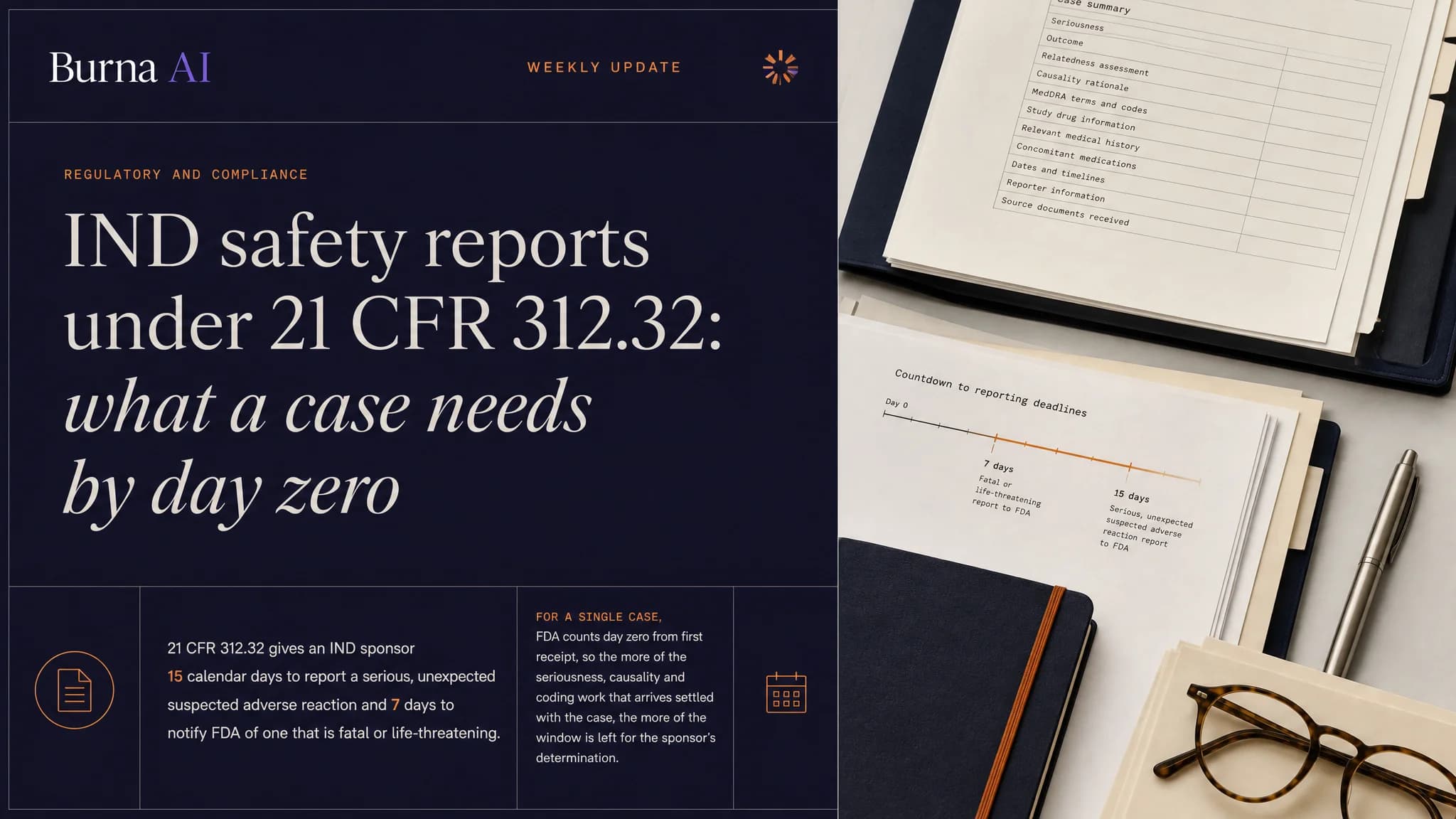
An IND safety report is the expedited report an IND sponsor sends to FDA and all participating investigators under 21 CFR 312.32 when a suspected adverse reaction is serious and unexpected, or other information suggests a significant risk to people exposed to the drug. It is due as soon as possible, and no later than 15 calendar days after the sponsor determines the information qualifies. An unexpected fatal or life-threatening suspected adverse reaction must also be notified to FDA no later than 7 calendar days after the sponsor first receives the information. The 15-day obligation to notify all participating investigators still applies.
The deadlines are fixed; what varies is how much of the case is settled when it arrives. For a single case, FDA's guidance counts day zero from the sponsor's initial receipt, so every day spent establishing seriousness, checking the investigator's brochure, working out causality and coding the event comes out of the 15 days.
What does 21 CFR 312.32 require?
21 CFR 312.32 requires an IND sponsor to promptly review all safety information it receives and report potential serious risks in an IND safety report. Section 312.32(a) defines the deciding terms:
- Suspected adverse reaction: an adverse event with a reasonable possibility the drug caused it, meaning there is evidence to suggest a causal relationship.
- Serious: in the view of either the investigator or the sponsor, the event results in death, a life-threatening adverse event, inpatient hospitalization or prolongation of existing hospitalization, a persistent or significant incapacity or substantial disruption of the ability to conduct normal life functions, or a congenital anomaly or birth defect. Important medical events that may jeopardize the participant and may require intervention to prevent one of those outcomes can also be serious (how serious differs from severe).
- Life-threatening: the event placed the participant at immediate risk of death, not one that might have caused death had it been more severe.
- Unexpected: not listed in the investigator's brochure, or not listed at the specificity or severity observed. Hepatic necrosis is unexpected when the brochure lists only elevated hepatic enzymes or hepatitis. An event the brochure mentions only as a class effect, or as anticipated from the drug's pharmacology, is also unexpected. Without a brochure, the comparison is against the general investigational plan or elsewhere in the current application.
Section 312.32(c)(1) names four kinds of report:
- Serious and unexpected suspected adverse reactions. Evidence of a causal relationship can be a single uncommon event strongly associated with drug exposure (angioedema, hepatic injury, Stevens-Johnson syndrome); one or more occurrences of an event otherwise uncommon in the exposed population (tendon rupture); or an aggregate analysis showing an event occurs more often on drug than in a control group.
- Findings from other studies, whether or not conducted under an IND, that suggest a significant risk in humans.
- Findings from animal or in vitro testing that suggest a significant risk in humans.
- A clinically important increase in the rate of a serious suspected adverse reaction over the rate listed in the protocol or investigator's brochure.
Each report must identify and analyze earlier IND safety reports on a similar suspected adverse reaction. A direct final rule published September 22, 2026 renames the third category "nonclinical" from February 4, 2027, adding no new requirements. Under 312.32(c)(5), study endpoints such as all-cause mortality are reported as the protocol describes, unless there is evidence of a causal relationship, as in death from anaphylaxis.
When do the 7-day and 15-day clocks start?
FDA's final guidance, Sponsor Responsibilities: Safety Reporting Requirements and Safety Assessment for IND and Bioavailability/Bioequivalence Studies (December 2025, section VIII), defines it: "Day zero for 7- and 15-day reports is considered as (1) the day the sponsor initially receives information for a case that is interpretable as a single case or (2) the day the sponsor determines that multiple cases qualify for expedited reporting."
| Report | What triggers it | Deadline | Day zero | Source |
|---|---|---|---|---|
| 15-day report, single case | Serious, unexpected suspected adverse reaction judged on its own | 15 calendar days, to FDA and all participating investigators | Initial receipt of the information | 312.32(c)(1) |
| 15-day report, more than one case | Causality needs several occurrences or an aggregate analysis | 15 calendar days | Date the sponsor determines the events qualify | 312.32(c)(1) |
| 7-day notification | Unexpected fatal or life-threatening suspected adverse reaction | 7 calendar days, to FDA; the 15-day report still follows | Initial receipt of the information | 312.32(c)(2) |
| Followup IND Safety Report | Relevant new information on a reported case | As soon as available | No fixed clock; labeled "Followup IND Safety Report" | 312.32(d)(2) |
| Late determination | An event first judged not reportable is found reportable | 15 calendar days | Date of that determination | 312.32(d)(3) |
| FDA request | FDA asks for additional data | 15 calendar days | Receipt of the request | 312.32(c)(1)(v) |
A worked example, as an illustration, in calendar days. On Monday, October 5, 2026, the sponsor first receives a site's report of a fatal hepatic event. That is day zero, even though the sponsor finishes judging the event an unexpected suspected adverse reaction later. FDA notification is due by Monday, October 12, and the IND safety report to all participating investigators by Tuesday, October 20.
Now suppose the report records attribution as one word and no onset date. The sponsor's query is answered on Friday, October 9. Four days have gone: 3 of the 7 remain for FDA notification, and 11 of the 15 for the IND safety report. The causality determination, the narrative and the submission fit into what is left.
Events anticipated in the study population, such as death from progressive disease in an oncology trial, are judged across cases under a safety surveillance plan written in advance, which FDA's guidance describes. The annual development safety update report carries the cumulative view.
ICH E2A starts the 15-day clock at the sponsor's first knowledge that a case meets the minimum criteria. The EU Clinical Trials Regulation uses the same day 0 in Annex III, with 7 days for a fatal or life-threatening SUSAR (suspected unexpected serious adverse reaction, the EU term) and 15 days for any other.
On the site side, 21 CFR 312.64(b) requires the investigator to report any serious adverse event to the sponsor immediately, with a causality assessment. FDA's investigator guidance (December 2025) expects the initial report generally within 1 calendar day; the EU regulation sets 24 hours, unless the protocol exempts certain events.
What does a case need by day zero?
A case ready for a reporting decision carries six things.
-
The minimum information. ICH E2A lists an identifiable patient, a suspect product, an identifiable reporter, and an event identifiable as serious and unexpected, with a reasonable suspected causal relationship.
-
Seriousness, set by outcome. ICH E2A is explicit that seriousness, not severity, defines reporting obligations, and a CTCAE grade measures severity. Grade 3 Fatigue under CTCAE v6.0, "not relieved by rest, limiting self-care ADL" for adults, managed at home, is severe but not serious unless judged an important medical event. A Grade 2 Fever that leads to an inpatient admission is serious, because of the outcome.
-
An event precise enough to check against the brochure. Expectedness turns on specificity and severity. In FDA's example, a brochure lists erythema and the report is Stevens-Johnson syndrome: more specific and more severe, so unexpected. "Rash, worsening" cannot be checked until someone queries the site.
-
A causality assessment with its reasoning. Section 312.64(b) requires the investigator's assessment, often made with causality scales such as WHO-UMC, Naranjo and Kramer. The sponsor makes the reporting judgment, and the guidance tells it not to report events the investigator called related when its own evaluation finds no evidence of a causal relationship. It calls that causality call "usually the most difficult determination".
That call is unstable: a recurring adverse event's attribution changes between visits for the same patient in 31 to 36% of cases (Hillman et al., JCO 2010), as adverse event attribution and the drug label sets out. In a combination regimen the question is asked once per drug; see multi-drug attribution in combination regimens.
-
The treatment assignment, in a blinded trial. FDA's sponsor guidance (section IV.A.1.a) says the blind should ordinarily be broken for an individually reportable serious, unexpected case, because the treatment received is needed to judge it. A participant on placebo is not reported in an IND safety report; one on the investigational drug or an active comparator must be.
-
A MedDRA code. FDA's regional implementation guide for E2B(R3) asks for the MedDRA Lowest Level Term, recorded as its numeric code, when possible. Each CTCAE v6.0 term is a MedDRA 28.0 Lowest Level Term, and each v5.0 term a MedDRA 20.1 term, so a graded event arrives with a candidate code the safety team confirms in the MedDRA version the report declares.
How are IND safety reports submitted: E2B(R3) or Form FDA 3500A?
The regulation, at 312.32(c)(1)(v), allows a narrative format, Form FDA 3500A, or an electronic format FDA can process. Foreign suspected adverse reactions may go on a CIOMS I form, and every notification must be labeled "IND Safety Report".
FDA's electronic submission requirement narrows that. Since April 1, 2026, reports under 312.32(c)(1)(i) go electronically to the FDA Adverse Event Monitoring System (AEMS, formerly FAERS) using the E2B(R3) standard. Reports under (c)(1)(ii) to (iv) go in eCTD format. Noncommercial INDs, such as investigator-sponsored and expanded access INDs, are exempt; the sponsor guidance points them to Form FDA 3500A, submitted as a PDF in FDA's alternate electronic format.
Where do the 15 days go between the site visit and the IND safety report?
The event is written into the clinical note; the investigator decides seriousness and attribution; a coordinator enters it in the EDC and completes the SAE form; the sponsor's safety team codes it, checks the brochure and determines causality. Each handoff can produce a query: a missing onset date, a description that maps to no term, an attribution with no reasoning. For a single case, the clock runs while those queries are open.
Burna AI works on the site side of that path:
- It grades the adverse events in the note against the CTCAE version the protocol names, v5.0 or v6.0, and assigns the MedDRA Lowest Level Term.
- It scores attribution against every drug in the regimen with the WHO-UMC and Kramer methods, reasoning shown.
- Every grade traces to the line in the medical record that produced it.
- A qualified investigator signs with a 21 CFR Part 11 electronic signature, and the platform produces FDA MedWatch, IRB and serious adverse event reports from the graded record, as the dated capability record lists.
AI suggests, clinicians decide. Human-in-the-loop, always.
The expectedness check, the reporting determination and the IND safety report stay with the sponsor's safety team, where 312.32 places them. What changes is what arrives: a case whose seriousness, attribution and coding come with their evidence, and the value runs past the 15 days. Attribution at the moment of decision, recorded with its evidence during the trial, is the safety record the eventual label is written from.
Common questions about IND safety reports
Does a 7-day report replace the 15-day IND safety report?
No. The 7-day notification goes to FDA for an unexpected fatal or life-threatening suspected adverse reaction. The IND safety report to FDA and all participating investigators is still due within 15 calendar days.
Do IND safety reports go to the IRB?
Yes, through the investigator. FDA's investigator guidance (section VI) says the investigator must submit IND safety reports to the IRB under 21 CFR 312.66. FDA considers safety information that meets the 312.32(c) criteria an unanticipated problem involving risk to participants.
Is SUSAR reporting the same as IND safety reporting?
Not quite. SUSAR is the EU term for what 312.32(c)(1)(i) calls a serious and unexpected suspected adverse reaction. An IND safety report is the US submission, and it also covers findings from other studies, nonclinical findings and increased rates. More on the term in what a SUSAR is.
If you run safety reporting and want to see an adverse event graded, attributed and coded with its evidence, and the SAE report built from it, book a 15-minute conversation.