
REGULATORY AND COMPLIANCE · OCT 2, 2026 · 8 MIN READ
Serious adverse event definition: why serious is not severe
A serious adverse event is defined by its outcome, not its CTCAE grade. FDA and ICH E2A set the criteria, the investigator or the sponsor can make an event serious, and the reporting clocks follow seriousness.
Burna AI Team
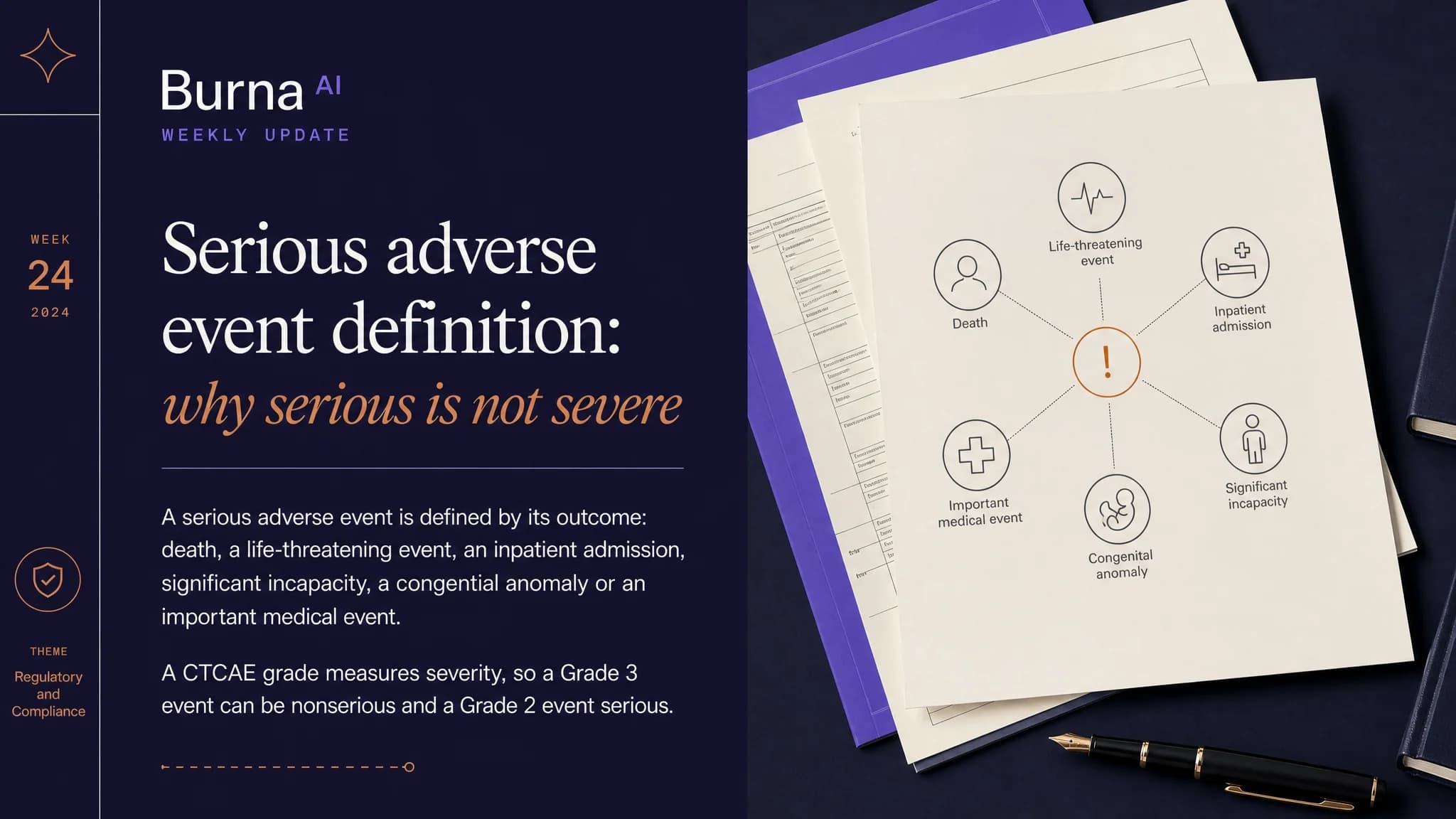
A serious adverse event (SAE) is an adverse event that results in death, is life-threatening, requires inpatient hospitalization or prolongs an existing stay, causes persistent or significant incapacity, or is a congenital anomaly or birth defect. Important medical events that may need intervention to prevent one of those outcomes can be serious too. That is the serious adverse event definition in FDA's 21 CFR 312.32(a) and in ICH E2A: it turns on what happened to the participant, while a CTCAE grade measures how intense the event was.
So every adverse event on a study carries two separate answers. A Grade 3 headache that keeps a participant in bed at home is severe and not serious. A Grade 2 fever that leads to an inpatient admission is serious. ICH E2A puts the consequence in one line: "Seriousness (not severity) serves as a guide for defining regulatory reporting obligations."
Serious adverse event definition: the six criteria
Under 21 CFR 312.32(a), an adverse event is "any untoward medical occurrence associated with the use of a drug in humans, whether or not considered drug related." It is serious when, "in the view of either the investigator or sponsor," it results in one of the outcomes below. ICH E2A, the ICH guideline on expedited reporting dated 27 October 1994, lists the same set.
| Criterion | The test | The common misreading |
|---|---|---|
| Death | The adverse event results in death | That only deaths judged drug related count. The definition covers every adverse event, related or not. |
| Life-threatening | The event placed the participant "at immediate risk of death" as it occurred | That a Grade 4 event is automatically life-threatening. The regulation excludes an event that "had it occurred in a more severe form, might have caused death." |
| Hospitalization | The event results in inpatient hospitalization or prolongs an existing one | That the Grade 3 phrase "hospitalization indicated" settles it. The criterion is an admission that happened. |
| Incapacity | "A persistent or significant incapacity or substantial disruption of the ability to conduct normal life functions" | That the Grade 3 phrase "limiting self-care ADL" settles it. The outcome is judged, not the grade wording. |
| Congenital anomaly | A congenital anomaly or birth defect | None in particular: it is serious whatever the severity. |
| Important medical event | Medical judgment that the event may jeopardize the participant and may need intervention to prevent one of the outcomes above | That an event fitting no other row is nonserious. The regulation's examples include allergic bronchospasm requiring intensive treatment in an emergency room or at home, blood dyscrasias or convulsions without inpatient hospitalization, and drug dependency or abuse. |
For medical devices, FDA's MedWatch page on serious adverse events adds intervention required to prevent permanent impairment or damage.
Serious vs severe adverse events: what is the difference?
ICH E2A includes a note of clarification because the two words are "not synonymous." "Severe" describes the intensity of a specific event, as in a mild, moderate or severe myocardial infarction, and the event itself may be of minor medical significance, "such as severe headache." "Serious" is "based on patient/event outcome or action criteria."
CTCAE sits on the severity side. Its general guideline in both versions opens: "Grade refers to the severity of the AE." NCI's own adverse event reporting guidelines for its IND trials (effective August 30, 2024) say it in capitals: a severe AE, as defined by the grading scale, "is NOT the same as serious AE."
A version change shows how independent the two are. CTCAE v6.0 moved the cutoffs for Neutrophil count decreased: an absolute neutrophil count of 300/mm3 is Grade 4 under v5.0 ("<500/mm3") and Grade 3 under v6.0 ("<500 - 100/mm3"). Same participant, same value, two grades. Whether that event was serious did not move, because nothing about its outcome changed. ctcae.ai lists every CTCAE v6.0 change, term by term.
Where CTCAE wording and the SAE criteria sound alike
Three of the general grade descriptions borrow the vocabulary of seriousness. CTCAE v5.0 and v6.0 print the same phrases here.
| CTCAE general wording | SAE criterion | The difference |
|---|---|---|
| Grade 3: "hospitalization or prolongation of hospitalization indicated" | "inpatient hospitalization or prolongation of existing hospitalization" | Grade 3 asks whether admission is indicated. It is one of several conditions separated by semicolons, and any one of them sets the grade. The criterion asks whether an admission happened. |
| Grade 4: "Life-threatening consequences; urgent intervention indicated" | The event "places the patient or subject at immediate risk of death" | For a laboratory term, Grade 4 can be a value alone. The criterion asks whether the participant was at immediate risk of death as the event occurred. |
| Grade 5: "Death related to AE" | Death | Both describe an event that ended in death. Seriousness does not depend on whether the death is attributed to the drug. |
Grade 3 but not serious, Grade 2 but serious: four examples
Each grade below quotes the clause of the CTCAE v6.0 criterion that applies, and the event takes the same grade under v5.0.
| Event | Grade and criterion | What happened | Serious? |
|---|---|---|---|
| Headache | Grade 3: "Severe pain; limiting self-care ADL" | Kept the participant in bed for two days; managed at home, no admission | No. No outcome criterion is met. It is ICH E2A's own example of severe but not serious. |
| Fever | Grade 2: ">39.0 - 40.0 degrees C (102.3 - 104.0 degrees F)" | Admitted as an inpatient for two days of evaluation | Yes: inpatient hospitalization. |
| Seizure | Grade 2: "Brief generalized seizure" | A participant with a known seizure disorder has one brief generalized seizure; seen in the emergency department and sent home | Possibly. No admission, but the regulation lists convulsions without inpatient hospitalization as an important medical event, so medical judgment decides. A first seizure on study would be Grade 3 ("New onset seizures"). |
| Neutrophil count decreased | Grade 4: "<100/mm3; <0.1 x 10^9/L" | Found on scheduled labs, no fever, no admission | Not by the grade. It is serious only if judged life-threatening as it occurred, or an important medical event; the regulation lists blood dyscrasias among its examples. |
Who decides whether an adverse event is serious?
The investigator assesses first. Under 21 CFR 312.64(b), an investigator must immediately report any serious adverse event to the sponsor, "whether or not considered drug related," with an assessment of whether there is a reasonable possibility the drug caused it.
Either party can make an event serious. FDA's guidance on sponsor safety reporting responsibilities states that if the sponsor or investigator believes the event is serious, "the event must be considered serious" and evaluated by the sponsor for expedited reporting. A sponsor that disagrees still evaluates it.
The protocol decides the rest. Section 312.64(b) lets study endpoints that are SAEs, such as all-cause mortality, be reported as the protocol specifies unless there is evidence of a causal relationship. NCI's guidelines (section 1.1, page 4) state that the SAE reporting procedures in a study protocol "will always supersede" its own. That makes the protocol's SAE section the first thing to read on a new study. A free protocol conformance report lists every place two passages give opposite directions on seriousness, with both passages and both page numbers. Where the document set gives no instruction on seriousness, the report says so.
SAE reporting timelines: who reports what, and when
On a US IND study the investigator reports every SAE to the sponsor immediately, which FDA expects generally within 1 calendar day; on an EU trial the limit is 24 hours. The sponsor then reports serious and unexpected suspected adverse reactions to FDA within 15 calendar days, or 7 calendar days when they are fatal or life-threatening.
| Who | Reports | To | Clock | Source |
|---|---|---|---|---|
| Investigator, US IND study | Every SAE, related or not, with a causality assessment | Sponsor | Immediately; FDA "anticipates that the time frame for submission of initial information will generally not exceed 1 calendar day" | 21 CFR 312.64(b); FDA investigator guidance, December 2025 |
| Investigator, US IND study | Unanticipated problems involving risk, including IND safety reports received from the sponsor | IRB | Promptly, under the IRB's written procedures | 21 CFR 312.66; FDA investigator guidance, section VI |
| Sponsor, US IND | Serious and unexpected suspected adverse reactions | FDA and all participating investigators | No later than 15 calendar days; day zero is initial receipt for a single case, or the date the sponsor determines that multiple cases qualify | 21 CFR 312.32(c)(1); FDA sponsor guidance, December 2025 |
| Sponsor, US IND | Unexpected fatal or life-threatening suspected adverse reactions | FDA | 7 calendar days after initial receipt | 21 CFR 312.32(c)(2) |
| Investigator, device study (IDE) | Unanticipated adverse device effects | Sponsor and IRB | 10 working days after first learning of it | 21 CFR 812.150(a)(1) |
| Investigator, EU trial | SAEs, unless the protocol exempts them | Sponsor | Within 24 hours of obtaining knowledge | Regulation (EU) No 536/2014, Article 41 |
| Sponsor, EU trial | Suspected unexpected serious adverse reactions (SUSARs) | EudraVigilance | 7 days if fatal or life-threatening; 15 days otherwise | Regulation (EU) No 536/2014, Article 42 |
| Site, NCI-sponsored IND trial (late phase 2 or phase 3) | SAEs within 30 days of the last dose of the investigational agent | NCI through CTEP-AERS | 24-hour notification, then a complete report within 10 calendar days (Grade 1 to 3) or 5 calendar days (Grade 4 to 5) | NCI guidelines, Appendix 1, page 31 |
No clock in this table starts because of a grade. Grade appears only in NCI's row, where it sets how quickly the complete report follows for an event already judged serious, and that row covers Grade 1 to 3 SAEs too. A version change can move that route: judged serious on such a trial, the neutrophil count above would need its complete report in 5 calendar days at Grade 4 under v5.0 and 10 at Grade 3 under v6.0. For how the sponsor's clocks run, see IND safety reports under 21 CFR 312.32.
How does a graded adverse event become an SAE report?
- The grade. The term and grade come from the CTCAE version the protocol names, with the criterion text that set the grade.
- Seriousness, asked on its own. The answer is serious or not serious and, if serious, the criterion that was met. Until the investigator has assessed it, the answer is "not yet assessed", which is different from "not serious".
- The report to the sponsor. It goes immediately, on the sponsor's SAE form or in the EDC, with the investigator's causality assessment; more data can follow the initial report.
- The IRB. Unanticipated problems go to the IRB under its written procedures. Where the sponsor sends IND safety reports to the IRB and the investigator receives confirmation, FDA's investigator guidance (section VI, footnote 18) does not expect a duplicate copy, and the agreement should be documented.
Burna AI works on the severity side and on the reports that follow. It grades each adverse event in the note against the CTCAE version the protocol names, v5.0 or v6.0, assigns the MedDRA Lowest Level Term, and scores attribution for each drug in the regimen with the WHO-UMC and Kramer methods, with the reasoning shown. Every grade traces to the line in the medical record that produced it. A qualified investigator signs with a 21 CFR Part 11 electronic signature, and the platform produces FDA MedWatch, IRB and serious adverse event reports from the graded record. Seriousness remains the determination the investigator or sponsor makes against the criteria above. AI suggests, clinicians decide. Human-in-the-loop, always.
Common questions about serious adverse events
Is a Grade 3 adverse event a serious adverse event?
Not automatically. A Grade 3 event is serious only if it meets an outcome criterion, most visibly an inpatient admission, or the investigator or sponsor judges it an important medical event. The meaning of each grade is set out in CTCAE grades 1 to 5, explained.
What is the difference between an adverse event and a serious adverse event?
Under 21 CFR 312.32(a), an adverse event is any untoward medical occurrence associated with the use of a drug in humans, whether or not considered drug related. A serious adverse event is the subset with a serious outcome. Neither requires the drug to have caused it; causality is a third, separate assessment.
Does an emergency department visit make an event serious?
Not by itself, because the hospitalization criterion is inpatient. An event treated in the emergency department can still be serious as an important medical event; the regulation's own example is allergic bronchospasm requiring intensive treatment in an emergency room. NCI's guidelines for its trials (section 2.1.14, page 8) count an inpatient stay of 24 hours or more, and exclude admissions for observation or minor treatment such as hydration that end in under 24 hours.
Is a planned hospitalization a serious adverse event?
The FDA definition and ICH E2A do not single out planned admissions, so the protocol's SAE section decides. NCI's guidelines for its trials state that a pre-existing condition identified at baseline is not an adverse event (section 5.1) and that a hospitalization for pharmacokinetic sampling is not reported (section 2.1.14). A pre-existing condition that worsens on study is reassessed for expedited reporting.
Does every serious adverse event go to the IRB?
No. Under 21 CFR 312.66 the investigator reports unanticipated problems involving risk to participants or others. FDA's investigator guidance treats IND safety reports as unanticipated problems, and an IRB's written procedures may ask for other events as well, so the IRB's own policy is the one to check.
To see an adverse event graded with its source line, its attribution scored per drug, and the SAE report built from the record, book a 15-minute conversation.