
PHARMACOVIGILANCE · OCT 2, 2026 · 9 MIN READ
The DSUR: what a development safety update report contains and when it is due
What a DSUR contains under ICH E2F, how the development international birth date sets its annual reporting period, when it is due, and how it meets FDA and EU annual reporting rules.
Burna AI Team
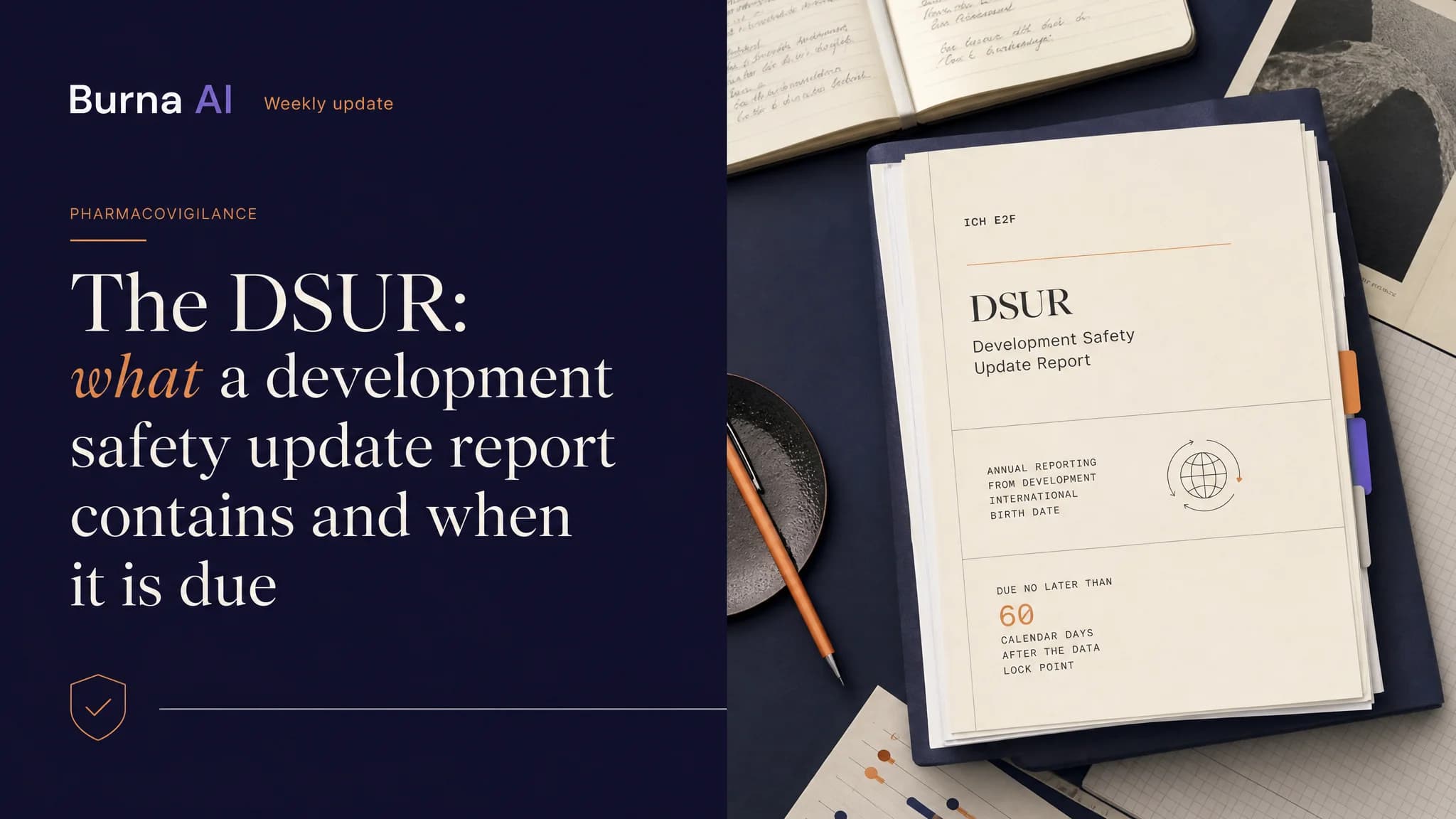
A DSUR, or development safety update report, is the annual safety report a sponsor prepares for each drug in clinical development, in the format set by the ICH E2F guideline. Its one-year reporting period starts on the development international birth date (DIBD), the sponsor's first authorization to run a clinical trial in any country. It is due no later than 60 calendar days after the data lock point.
FDA accepts a DSUR to meet the IND annual report requirement of 21 CFR 312.33. In the EU, EMA describes the annual safety report under the Clinical Trials Regulation as the report "formerly known as the Development Safety Update Report."
E2F 1.2 gives the report four jobs:
- Show whether the year's safety information is in accord with what was already known about the drug.
- Describe new safety issues that could affect the protection of trial participants.
- Summarize the current understanding and management of identified and potential risks.
- Update the status of the development program and its study results.
E2F says the DSUR should not be the first notice of a significant new safety issue. That goes to regulators through expedited reports, such as IND safety reports under 21 CFR 312.32; the DSUR then discusses it.
What does a DSUR cover in clinical trials?
A DSUR covers a drug's whole clinical development program, whether or not the drug is marketed. Under E2F 1.3, that includes:
- interventional clinical trials, phase 1 to phase 4, including trials run to support manufacturing changes
- therapeutic use outside trials, such as expanded access, compassionate use, single-patient INDs and treatment INDs
- significant safety findings from observational and nonclinical studies, the literature, other DSURs for the same drug and, where the contract permits, a co-development partner's trials
ICH finalized E2F in August 2010 as one standard in place of region-by-region annual reports. It asks for one DSUR per active substance wherever feasible, covering all dosage forms, strengths, indications and populations under study.
Combination therapy has its own rule. For a multi-drug regimen that is not a fixed combination, as in many oncology trials, E2F 2.5 offers two options. The sponsor can write one DSUR for the regimen, or carry the regimen's data in the DSUR of one or more of its components.
When is a DSUR due?
A DSUR is due no later than 60 calendar days after its data lock point, which is the last day of the one-year reporting period that starts on the DIBD. Under E2F 2.2, three dates and the period between them set that clock. The example below is the third annual report of a program first authorized to run a trial on March 14, 2023, with E2F's two choices of data lock point side by side.
| Date | What E2F says | Anniversary data lock point | Month-end data lock point |
|---|---|---|---|
| Development international birth date (DIBD) | The sponsor's first authorization to conduct a clinical trial in any country. Each annual period starts on its month and day. | March 14, 2023 | March 14, 2023 |
| Reporting period | One year | March 14, 2025 to March 13, 2026 | March 1, 2025 to February 28, 2026 |
| Data lock point | The last day of the reporting period or, for administrative convenience, the last day of the month before the DIBD month | March 13, 2026 | February 28, 2026 |
| Due date | No later than 60 calendar days after the data lock point, to all concerned regulatory authorities | May 12, 2026 | April 29, 2026 |
When trials later open in another country, the original DIBD stays in force for every country. DSURs continue for as long as national or regional law requires (E2F 2.3). In the US, that means for as long as the IND stays open, even with no trial running.
What sections does a DSUR contain under ICH E2F?
A DSUR opens with a title page and an executive summary that can stand alone, followed by 20 numbered sections and its appendices (E2F 2.7.2 and 3). Every section is completed; where no information is available, the section says so.
The executive summary covers exposure, approval status, the overall safety assessment, important risks, safety actions and conclusions. The appendices hold the investigator's brochure, the section 7 listings and tabulation, and supporting tables.
| DSUR section | Title | What goes in it |
|---|---|---|
| 1 | Introduction | DIBD, reporting period, the drug, indications and populations |
| 2 | Worldwide marketing approval status | First approval date, indications and countries |
| 3 | Actions taken for safety reasons | Suspensions, early terminations and safety-driven protocol changes |
| 4 | Changes to reference safety information | Significant safety changes to the investigator's brochure during the period |
| 5 | Inventory of clinical trials | Each ongoing and completed trial, with phase, status and enrollment |
| 6 | Estimated cumulative exposure | Participants exposed since the DIBD, and exposure from marketing |
| 7 | Line listings and summary tabulations | Dictionary version, serious adverse reaction listings, cumulative SAE tabulation |
| 8 | Significant findings from clinical trials | Completed and ongoing trials, expanded access, combination therapies |
| 9 | Noninterventional studies | Registries, observational and epidemiological studies |
| 10 | Other trial and study information | Pooled analyses and partner trials |
| 11 | Marketing experience | Safety findings from marketed use |
| 12 | Nonclinical data | Major in vivo and in vitro findings |
| 13 | Literature | New, significant safety findings, published or not |
| 14 | Other DSURs | Findings from other DSURs for the same drug |
| 15 | Lack of efficacy | Sponsor data suggesting the drug may not work in a serious condition, where that puts participants at risk |
| 16 | Region-specific information | Items a national authority requires, such as the US items below |
| 17 | Late-breaking information | Important findings after the data lock point |
| 18 | Overall safety assessment | An integrated evaluation of risks and a benefit-risk statement |
| 19 | Summary of important risks | Identified and potential risks, re-evaluated each year |
| 20 | Conclusions | What changed since the last DSUR, and the actions taken or planned |
Reference safety information decides which reactions count as unexpected. Under E2F 2.6, the investigator's brochure in effect at the start of the reporting period serves as the reference safety information for the whole period. Section 7.1 names its version and date. Where no brochure is required, the national product label serves.
How do the DSUR line listings and tabulations work?
Section 7 is where adverse event data from every study in the program meets, in two sets (E2F 3.7):
- Interval line listings of serious adverse reactions (SARs): serious events with a reasonable possibility that the drug caused them, reported during the period and organized by trial, then by System Organ Class.
- Cumulative summary tabulations of serious adverse events: every serious adverse event since the DIBD, related or not, by System Organ Class, for the investigational drug and each comparator arm, including placebo and arms still blinded.
A line listing row looks like this, with the reaction as a MedDRA Preferred Term:
| Study | Case | Treatment group | Dose | Onset | Reaction (MedDRA PT) | Outcome | Comments |
|---|---|---|---|---|---|---|---|
| ABC-201 | 2026-0147 | Blinded | 200 mg every 3 weeks | Day 43 | Pneumonitis | Improved | Sponsor assesses as possibly related; reporter as unrelated |
Illustrative, fictional row. E2F Appendix B, Table 5 gives the full set of headings.
The comments column is where that disagreement goes. E2F 3.7.2 lists the sponsor's causality assessment, where the sponsor disagrees with the reporter, as the first example of what the column records.
E2F also explains why the tabulations take every serious adverse event. Case-by-case causality assessment helps with a rare reaction or an expedited reporting decision. It has less value in aggregate data, where rates can be compared between groups.
Individual calls also move: a recurring adverse event's attribution changes between visits for the same patient in 31 to 36% of cases (Hillman et al., JCO 2010), one of the findings in adverse event attribution and the drug label.
Under E2F 3.7, the tabulations generally include only the terms that made a case serious, and no nonserious events. They include blinded and unblinded data, and sponsors should not unblind data for the purpose of writing the DSUR.
Two kinds of event can be left out, if the report explains the exclusion. The first is an event the protocol exempts from special collection and entry into the safety database. The second is an event integral to an efficacy endpoint, such as disease progression in a cancer trial.
What does FDA guidance say about the DSUR?
FDA accepts a DSUR to meet the IND annual report requirement of 21 CFR 312.33, and adopted ICH E2F as guidance for industry in August 2011. Section 312.33 requires an IND sponsor to submit a brief progress report within 60 days of the anniversary of the date the IND went into effect. FDA's IND annual reports page states that FDA will accept the DSUR to meet that requirement.
DSUR section 16 (E2F 3.16) and its regional appendices carry the 312.33 items the core report lacks, including:
- a list of subjects who died during participation, with the cause of death
- a list of subjects who dropped out in association with any adverse experience, whether or not thought to be drug related
- significant Phase 1 protocol modifications
- significant manufacturing changes
- the general investigational plan for the coming year
The two reports run on different clocks: the IND annual report from the IND's effective date, the DSUR from the DIBD. Under 21 CFR 312.10, a sponsor may ask FDA to waive an applicable part 312 requirement. Without a waiver, the annual report stays due within 60 days of the IND anniversary.
In December 2022, FDA proposed replacing the IND annual report with an annual FDA DSUR. It wrote that waiver criteria under 312.10(b) "will likely be met" for an alternate data lock point aligned, for example, with the DIBD. As of October 2026, the Federal Register lists no final rule under docket FDA-2020-N-0258, so section 312.33 still governs.
Who receives the DSUR?
A DSUR goes each year to every concerned regulatory authority and, where national law asks for it, to ethics committees and IRBs:
- FDA, as the IND annual report.
- EMA, under CTR Article 43. Article 43 of the Clinical Trials Regulation (EU) No 536/2014 requires a yearly report on the safety of each investigational medicinal product other than placebo. It goes to EMA through the safety database set up under Article 40(1), with only aggregate and anonymized data.
- The CTIS safety module. EMA guidance for Member States, dated September 24, 2026, describes a CTIS safety module that takes a report for one trial or for a substance group.
- Other concerned regulatory authorities, under their own national rules (E2F 2.2).
- Ethics committees and IRBs, where national law requires an annual safety report. E2F suggests the executive summary, supplemented with line listings of serious adverse reactions as warranted.
How the DSUR relates to the PSUR and PBRER
The DSUR looks at a drug under development; the PSUR and its successor, the PBRER, look at a drug on the market. Each stands alone (E2F 1.4). The full comparison, including FDA's PADER, is in DSUR, PSUR, PBRER and PADER compared.
What event data keeps the section 7 tabulations consistent?
The cumulative tabulation reaches back to the DIBD, so an event coded in year one sits beside one coded last month. Three properties of the underlying event data decide whether those rows are comparable.
The dictionary version travels with the event. Section 7.1 names the coding dictionary version, and MedDRA publishes two releases a year, in March and September (MedDRA MSSO, 2026).
Oncology adds a second vocabulary. CTCAE v5.0 maps its terms to MedDRA 20.1 and v6.0 to MedDRA 28.0, so an event's code depends on the version that graded it (every v6.0 change, term by term). When each event records the CTCAE and MedDRA versions it was coded under, the cumulative tabulation can be brought to the single version section 7.1 names without returning to the source notes.
The grade and the code come from the same reading. A trial database needs the CTCAE grade; a safety database needs the MedDRA term. When different people read the note at different times for each, every divergence becomes a reconciliation item, and section 7 is the last place to find it.
Causality carries its reasoning. An attribution recorded with the drug, the method and the evidence is ready for the line listing's comments column, with no return to the site to reconstruct it.
Burna AI works at the site, where the adverse event is first documented. It grades each event in the note against the CTCAE version the protocol names, with its MedDRA LLT code. It scores attribution against every drug in the regimen with the WHO-UMC and Kramer methods, reasoning shown. Every grade traces to the line in the medical record that produced it, and a qualified investigator signs it with a 21 CFR Part 11 electronic signature. The signed record produces FDA MedWatch, IRB and serious adverse event reports (what Burna AI does today). AI suggests, clinicians decide. Human-in-the-loop, always.
The DSUR's safety assessment, benefit-risk statement and conclusions remain the sponsor's work. What improves is the event data underneath them. Attribution that holds during the trial is what the label's warnings, dosing intervals and monitoring schedule are built from, and E2F 3.19 describes important risks as those that might lead to warnings, precautions or contraindications in labeling. The same engine carries on after approval for postmarket surveillance.
DSUR FAQs: FDA, data lock point and nonserious events
Is a DSUR required by FDA?
Not in that form. FDA requires an IND annual report under 21 CFR 312.33 and accepts a DSUR to meet it. FDA's 2022 proposal to require an annual FDA DSUR remains a proposed rule.
What is the data lock point of a DSUR?
It is the last day of the one-year reporting period that starts on the DIBD, or, if the sponsor prefers, the last day of the month before the DIBD month. The DSUR is due within 60 calendar days of it, as the worked example above shows.
What is the difference between a DSUR and an IND safety report?
An IND safety report is an expedited report of a serious, unexpected suspected adverse reaction or other significant risk, due within 7 or 15 calendar days. The DSUR is the annual, cumulative review of the drug's safety profile.
Does a DSUR include nonserious adverse events?
No, not in its section 7 line listings and summary tabulations. E2F 3.7 limits the line listings to serious adverse reactions, and the tabulations to serious adverse events and, within each case, to the terms that made it serious. The tabulations do include every serious adverse event since the DIBD, whether or not it is related to the drug.
To see an adverse event graded, attributed and MedDRA-coded at the site with its evidence attached, book a 15-minute conversation.